The Productize

- Bonsai is better for freelancers managing contracts and invoices
- HoneyBook works well for service-based businesses needing client pipelines
- Both tools struggle with high-volume client request management
- Neither platform is optimized for scaling agency operations
- Choosing depends on workflow complexity and client volume
If you're comparing Bonsai vs HoneyBook for agencies, here’s the short answer: HoneyBook is the better choice for structured onboarding and client booking, while Bonsai works better for freelancers handling contracts and invoices. But for agencies managing ongoing client work, neither tool is a strong fit.
Both Bonsai and HoneyBook are built to help start client relationships. They handle contracts and payments well. If your workflow ends there, they can work well.
But being an agency, you don’t stop at onboarding. The real work starts after the deal is signed.
This is where things begin to break down.
Once you’re handling multiple clients and ongoing requests, delivering projects regularly, you start noticing the shortcomings:
- There’s no clear way for clients to track progress
- Project visibility is limited
- Managing requests across clients becomes disorganized
- The client experience drops
You end up jumping between tools and emails just to keep things moving.
This is why many agencies start looking for HoneyBook and Bonsai alternatives. Not because these tools are bad, but because they’re not built for delivery at scale.
So instead of just comparing features, this guide focuses on something more important: workflow fit…
- Which tool actually works for your stage of business?
- Where do they fall short for your agency?
- And what should you use if you’ve outgrown both?
Pre-Project vs Ongoing Workflow (Why this matters for agencies)
The biggest difference in the Bonsai vs HoneyBook comparison is when they work best in your workflow.
Both tools perform well pre-project. That is before a project starts.
They help you:
If your goal is to close deals faster and look professional, both tools do that well.
But you don’t make money from onboarding, but by delivering work over time.
Once a client is active, your workflow changes:
- Requests start coming in
- Tasks need to be tracked
- Team members need to collaborate
- Clients want updates without asking
It's in this (ongoing work) phase that both tools start to struggle:
Limited project tracking depth
Bonsai and HoneyBook offer basic project tracking. You can see tasks or timelines at a high level. But for agencies handling multiple clients, this isn't enough.
You need to:
- Track many tasks across different clients
- Assign work to team members
- Set priorities and deadlines
- See what is delayed
In both tools, this quickly becomes hard to manage. You end up relying on other tools just to keep things organized.
No real client-facing progress visibility
Besides results, clients want to monitor progress.
With Bonsai and HoneyBook, clients can sign contracts and pay. But they can’t easily track what’s happening next. There’s no clear dashboard showing work in progress.
So what happens?
Clients start asking questions:
“Any update on this?”
“What’s the status?”
“When will this be ready?”
Now your team spends time answering questions instead of doing the work.
No structured request management
This is one of the biggest issues for agencies.
Ongoing work usually comes in as requests:
- Design changes
- Content updates
- New tasks
- Revisions
In Bonsai and HoneyBook, there’s no proper system for this.
Requests come through:
- Slack
- Random messages
In this scenario, files can easily go missing and things can quickly go wrong.
There’s no single place where clients can submit requests and have your team manage them. They can't track progress either.
This alone can ruin operations for productized or retainer-based agencies.
Weak collaboration for ongoing work
As your agency grows, your team increases as more people get involved:
- Designers
- Developers
- Writers
- Project managers
You need a system where everyone can see what they need to do and update progress. A place they can work together without disorder.
Bonsai and HoneyBook aren't built for this level of collaboration. So teams end up switching between tools. And this slows everything down.
Limited client experience and branding
Client experience matters a lot.
According to McKinsey and Company, optimizing end-to-end client experience typically delivers 5–10 percent revenue growth and 15–25 percent cost reductions within 2–3 years. A clean client portal and branded experience are a good start. One place for communication, requests, updates and client feedback.
With Bonsai and HoneyBook, the experience is fixed and branding options are limited.
Hence many agencies move away from traditional client management software for agencies and look for tools built around complete delivery workflows, not just onboarding.
Instead of handling only proposals and payments, ManyRequests also:
- Manages client requests
- Tracks ongoing work
- Gives clients clear visibility
- Runs delivery in a structured way
Quick Comparison: Bonsai vs HoneyBook vs ManyRequests
| Feature | Bonsai | HoneyBook | ManyRequests |
|---|---|---|---|
| Built for | Freelancers | Freelancers / Solopreneurs | Agencies |
| Client portal | Basic | More polished | Fully branded |
| Request management | No | No | Yes |
| Proposals and contracts | Yes | Yes (bundled) | Yes |
| Recurring billing | Yes | Yes | Yes |
| Team seats | Per user (gets expensive fast) | Up to 2 on Essentials | Included |
| Design approvals | No | No | Yes |
| White-label | Premium plan only | Essentials and up | Yes |
| Free trial | 7 days | 7 days | 14 days |
Bonsai vs HoneyBook: Feature Breakdown
Features are great but how do they fit into your agency’s day-to-day workflow?
Let's look at major Bonsai and HoneyBook features in the light of how agencies work.
Proposals and Contracts
Both tools are strong here. This is what they were built to perform.
Bonsai:
- Clean proposal templates
- Easy contract creation
- Simple e-signatures
- Good for freelancers who want speed
HoneyBook:
- More guided workflows
- Combines proposals, contracts and payments in one flow
- Better for structured onboarding
What does this mean for your agency?
If your process is:
1. Send proposal
2. Get approval
3. Start work
Both tools can handle it.
But HoneyBook has an edge because it feels more structured and automated.
Verdict: For agencies that want a smoother onboarding flow, HoneyBook outperforms Bonsai here.
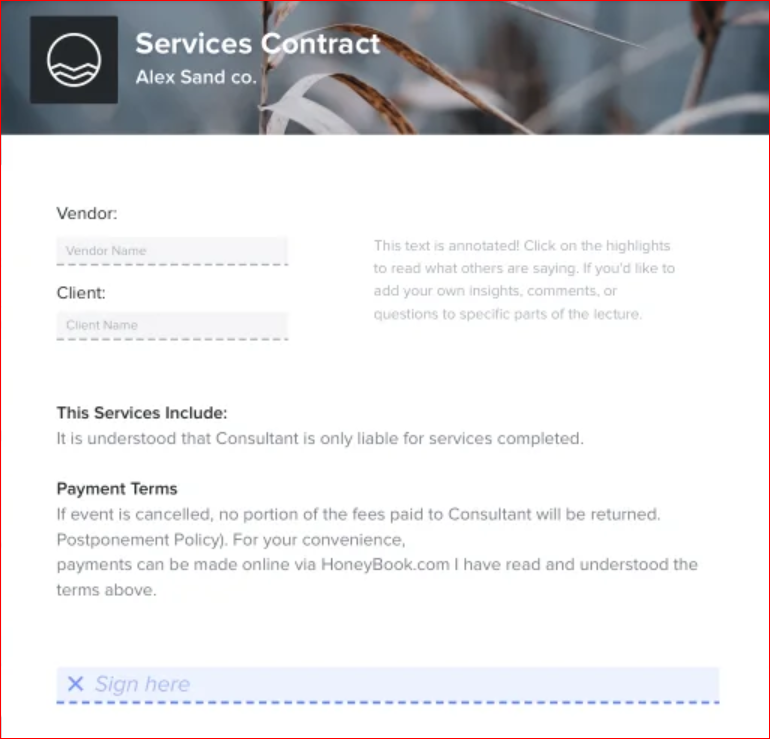
HoneyBook contract template
Client Management and CRM
This is where the differences start to show.
Bonsai:
- Basic client database
- Simple tracking of contacts and projects
Works fine if you’re managing a small number of clients
HoneyBook:
- Tracks leads from inquiry to booking
- Better automation for follow-ups
What this means for your agency:
HoneyBook is closer to a real CRM. You can:
- Track where each client is in your pipeline
- Automate parts of your sales process
Bonsai feels more like a lightweight tool. It works, but it’s limited.
That said, neither tool is built for complex agency workflows with:
- Multiple stakeholders and long-term client relationships
- Ongoing service delivery
Verdict: HoneyBook is better, but still not a full agency CRM.
Billing and Payments
Both tools handle payments well. This is one of their strongest areas.
Bonsai:
- Strong invoicing system
- Supports recurring invoices
- Includes time tracking
- Good for hourly or project-based billing
HoneyBook:
- Smooth payment experience for clients
- Can combine invoices with proposals
- Good automation for payment reminders
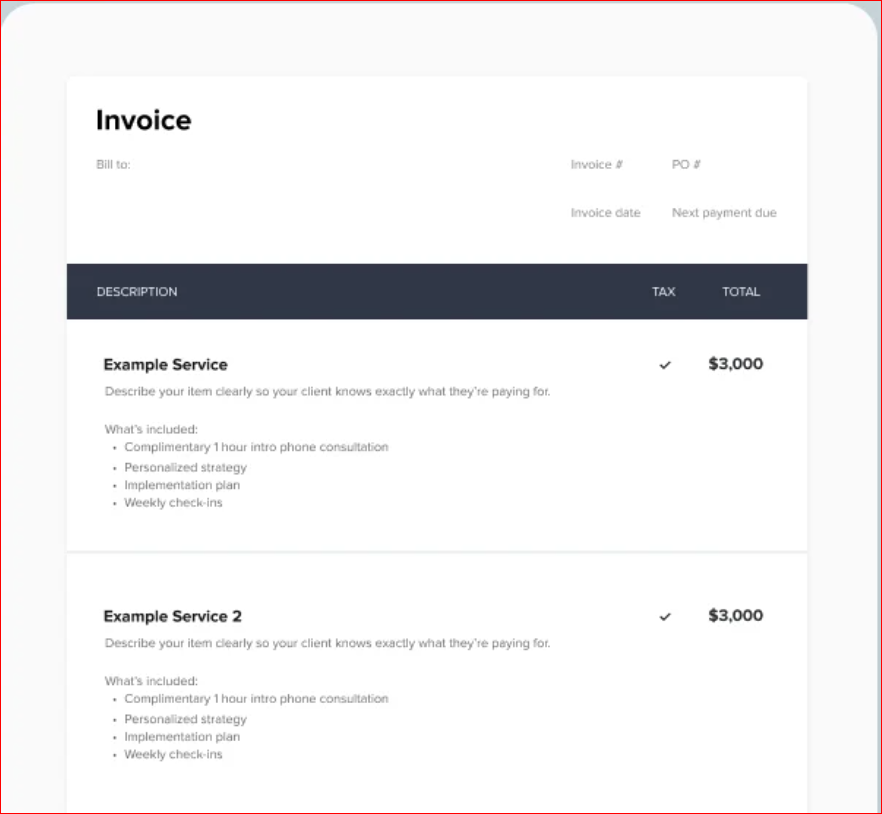
Honeybook invoice template
What this means for your agency:
If your revenue depends on:
- One-time projects
- Simple retainers
Both tools will work.
But once you move into subscription-style services and request-based monthly delivery, you start to feel limits of both tools.
Verdict: Tie. Choose based on your billing style.
Project Tracking and Delivery
This is the most important section for agencies. And this is where both tools fall short.
Bonsai:
- Basic task tracking and limited visibility across projects
- Not built for team workflows
HoneyBook:
- Focused more on onboarding than delivery
- Minimal tools for managing ongoing work
The issue is neither tool gives you:
- A clear system for handling client requests and managing multiple clients
- A shared workspace where clients can track progress
The implication in practice is requests come in through email or chat. Tasks get tracked in a separate tool. Clients ask for updates because they can’t see progress. Your team jumps between tools to get work done
This slows work down and creates a poor client experience.
Verdict: Neither tool works well for agency delivery.
Client Experience and Portal
An integral part of service delivery. Unfortunately, some agencies treat this as an afterthought.
Bonsai:
- Basic client view and limited customization
- Not designed as a full client portal
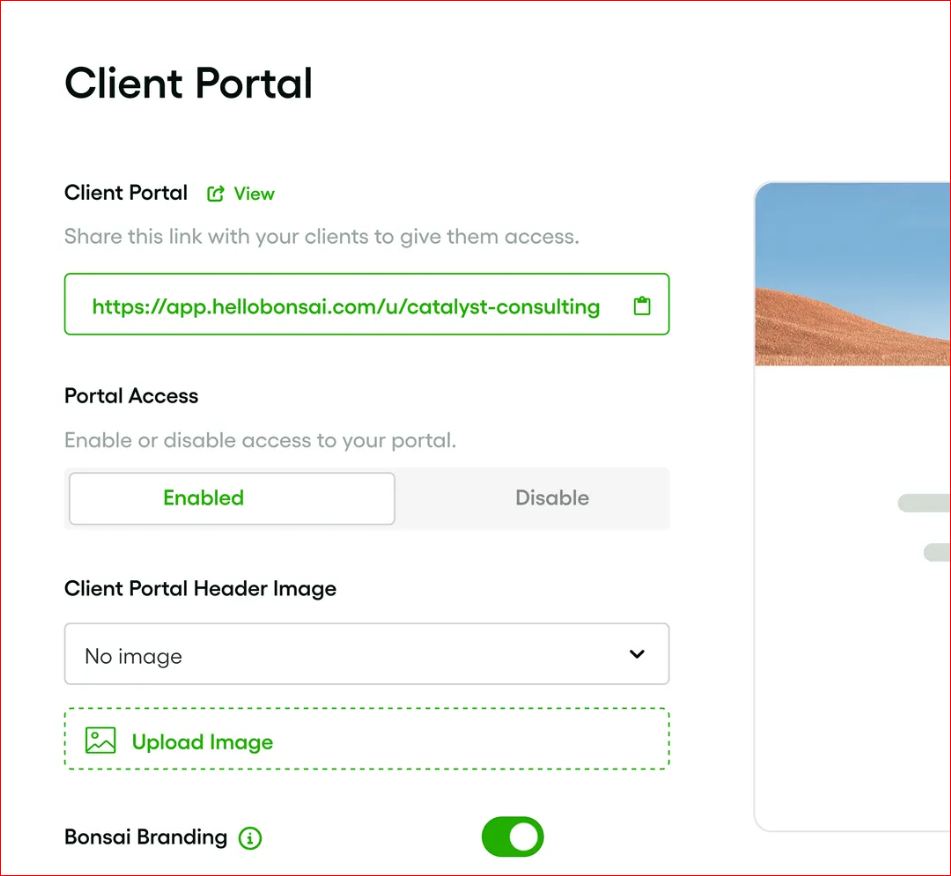
Bonsai client portal
HoneyBook:
- More polished client experience
- Better for onboarding and communication
What agencies actually need:
- A single place where clients can submit requests and track progress
- A branded professional experience
Both tools fall short here. The experience feels more like a transaction system and not a working relationship.
Verdict: HoneyBook is slightly better, but neither delivers a strong client portal.
Both tools are weak when it comes to ongoing agency work.
Once delivery becomes your main focus, features alone aren't enough.
You're better off with a tool built around how agencies actually run day to day.
Bonsai vs HoneyBook for Agencies: Use Case
Both tools built for different types of businesses. The mistake most agencies make is picking based on features, instead of how they actually work day to day.
When Bonsai Makes Sense
Bonsai works best for freelancers and small teams.
It fits workflows where:
- You manage a few clients at a time
- Work is project-based or hourly
You also handle contracts and invoices yourself.
Typical use cases:
- Freelance designers
- Developers working per project
- Consultants billing by the hour
- Small creative teams with simple workflows
Bonsai works here because:
- It's easy to send contracts and invoices
- Time tracking is built in
- Basic project tracking is enough
- Setup is simple and fast
You don’t need a complex system. Bonsai gives you just enough to run things smoothly.
Bonsai struggles when:
- You take on many clients at once and you need a clear system for handling requests
- Work becomes continuous (ongoing) , not one-off
When HoneyBook Makes Sense
HoneyBook is built for service-based businesses which rely on bookings and onboarding.
It fits workflows where:
- Leads come in regularly
- You want fast approvals and payments
Typical use cases:
- Photographers
- Wedding planners
- Coaches and consultants
- Creative service providers
HoneyBook works here because:
- There's a strong client pipeline
- The onboarding experience is smooth
- Proposals, contracts and payments are in one flow
- Automation reduces back-and-forth
If your business depends on:
- Closing deals quickly
- Managing a steady flow of new clients
HoneyBook is a strong option.
But it starts to struggle when:
- Work continues after onboarding
- Clients stay long-term and you need to manage ongoing deliverables
HoneyBook is great at getting clients in.
It's not built to manage them long term.
What About ManyRequests?
Bonsai and HoneyBook are front-office tools, agencies need back-office systems.
Most agencies struggle with:
- Managing ongoing work
- Handling client requests
- Keeping everything organized
- Giving clients clear visibility
Neither Bonsai nor HoneyBook can handle all these. But ManyRequests, a tool built specifically for agencies does.
How does ManyRequests handle agency workflows better?
A real client portal (not just onboarding)
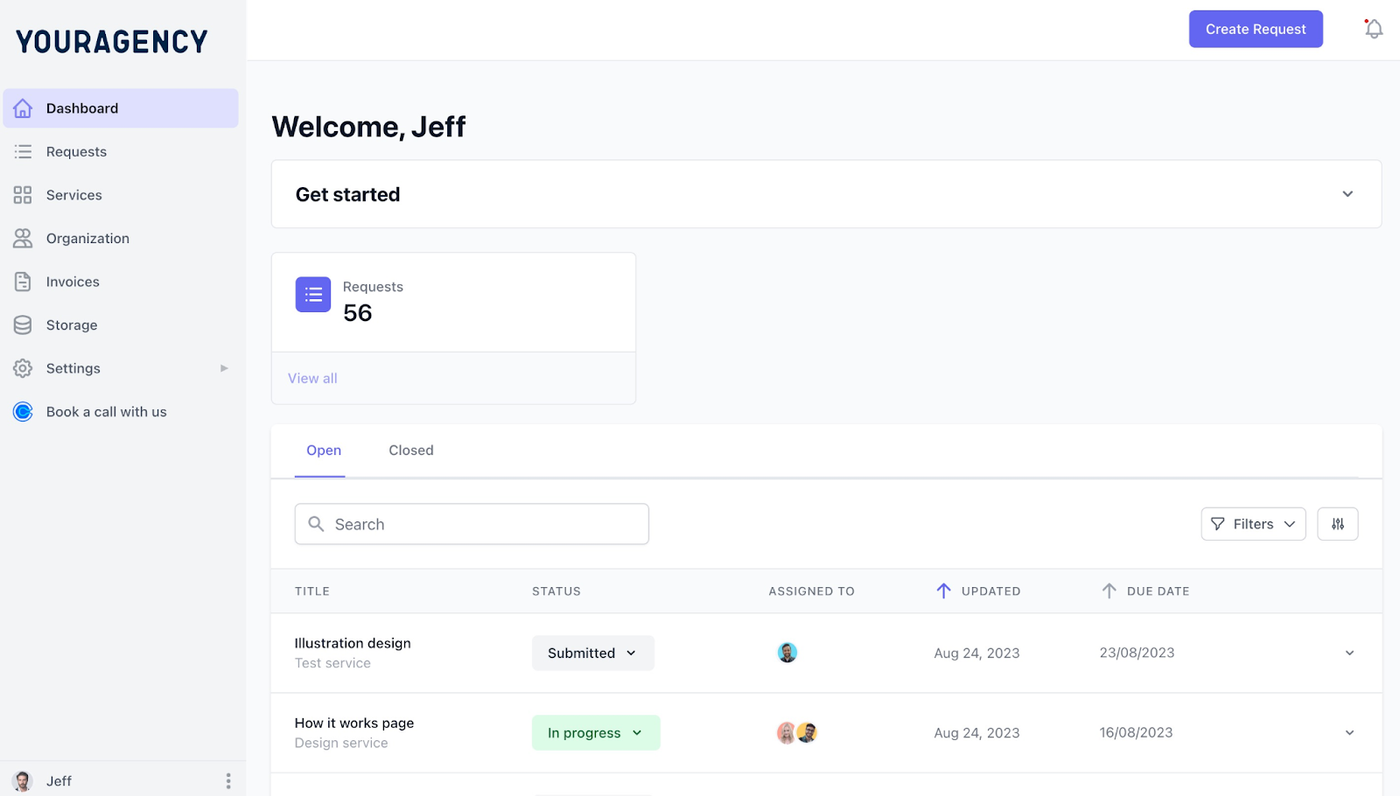
ManyRequests Client portal (Client view)
With ManyRequests, every client gets access to a dedicated portal.
Inside the portal, clients can:
- Submit new requests
- Track progress in real time
- View invoices and billing
- Access files and updates
Everything lives in one place, including agency-client communication. Clients can simply log in and see exactly what's happening without asking.
Structured request management
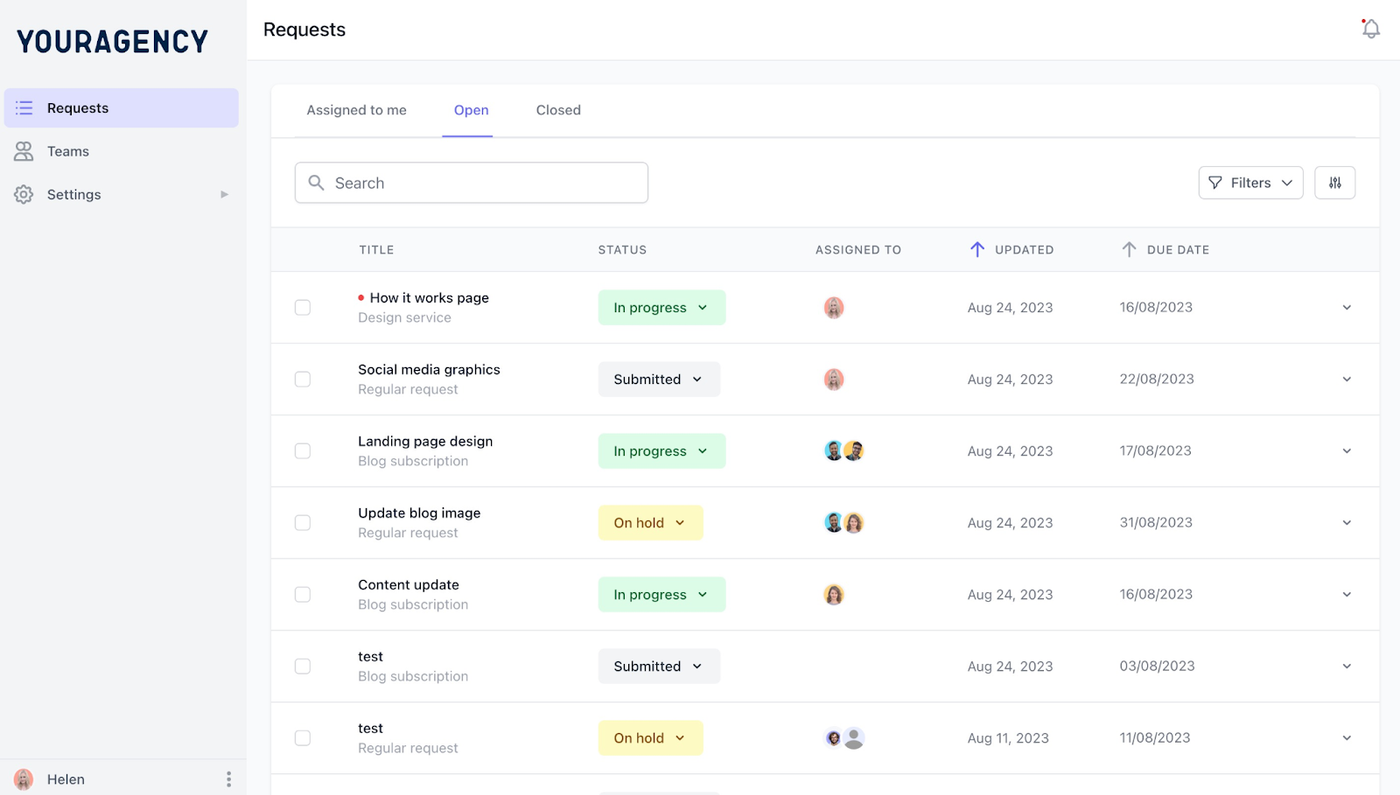
Requests (Team view)
Instead of tasks being created manually from emails, ManyRequests gives you a system where:
- Clients submit requests through a form
- Requests are tracked with status, priority and due dates
- Team members are assigned automatically
- Everything is visible and organized
You can filter and manage requests across all clients from one dashboard.
Built for ongoing, repeatable work
ManyRequests is built for different income models, including retainers and productized services.
You can offer services through a catalog, or let clients purchase or subscribe. Then manage delivery based on those services.
This is very different from Bonsai and HoneyBook, which treat each project as a separate event.
Clear client visibility
In ManyRequests, clients don’t need to ask for updates.
They can easily log in and see:
- Open requests
- Work in progress
- Completed tasks
- What needs their feedback
This reduces back-and-forth and saves time. It also builds trust through transparency, as everything is there for the client to see.
Everything connected in one workflow
Instead of using one tool for CRM, another for tasks and yet another for billing, ManyRequests connects requests, delivery, time tracking and billing in one potent system.
That means no switching between tools and no manual updates.
Your team and your clients see the same thing, in real time.
With Bonsai or HoneyBook:
- Client emails a request
- You turn it into a task
- You track it in another tool
- Client asks for updates
With ManyRequests:
- Client submits a request in the portal
- It is tracked automatically
- Team works on it
- Client sees progress without asking
That’s a completely different workflow.
Bonsai vs HoneyBook: Pricing
Should you go for the least expensive tool or the one which fits your workflow perfectly?
Bonsai Pricing
Bonsai charges per user per month. You can pay monthly or annually. Paying annually saves around 40%.
| Plan | Monthly | Annual (per user/month) | What you get |
|---|---|---|---|
| Basic | $15/user | $9/user | Time tracking, task management, basic CRM |
| Essentials | $25/user | $15/user | Proposals, contracts, client portal, invoicing |
| Premium | $39/user | $24/user | White-label, reporting, automation |
| Elite | $59/user | $36/user | Custom roles, advanced team ma |
Bonsai is affordable at the start. It works well for freelancers and small teams.
But as your agency grows, you may need higher plans. You may also still need extra tools (for project tracking, requests, etc.)
So your total cost increases outside Bonsai.
HoneyBook Pricing
Unlike Bonsai, HoneyBook charges a flat rate rather than per user. This makes costs easier to predict as your team grows. But the gap between Essentials and Premium is large.
| Plan | Monthly | Annual | What you get |
|---|---|---|---|
| Core | $36/month | $29/month | Invoicing, contracts, scheduling, basic portal |
| Essentials | $59/month | $49/month | Automation, integrations, 2 team members, white-label |
| Premium | $129/month | $109/month | Unlimited team members, multiple brands, advanced reporting |
HoneyBook is still affordable for small businesses. It works well if your focus is booking clients and managing leads.
But like Bonsai, once you grow, you may need other tools for delivery.
And costs increase as you stack tools.
ManyRequests Pricing
ManyRequests has three plans: Core, Pro and Scale, plus Enterprise for custom contracts. All plans include unlimited clients, a branded client portal, request management, billing, CRM, time tracking and reporting.
| Core | Pro | Scale | Enterprise | |
|---|---|---|---|---|
| Monthly price | $39/month | $99/month | $799/month | Custom |
| Annual price (save 30%) | $27/month | $69/month | $559/month | Custom |
| Seats included | 2 seats | 5 seats | Unlimited | Custom |
| Extra seats (monthly billing) | $10/seat/month | $14/seat/month | Included | Custom |
| Extra seats (annual billing) | $8/seat/month | $12/seat/month | Included | Custom |
| Unlimited clients | ✓ | ✓ | ✓ | ✓ |
| Free trial | 14 days | 14 days | 14 days | Book a demo |
| Best for | Small agencies | Growing agencies | Large agencies | Enterprise teams |
ManyRequests replaces multiple tools.
Instead of paying for:
- CRM
- Project management
- Request tracking
- Client portal,
You get everything in one place.
So while the monthly price is higher, the total cost of your stack can be lower.
Here’s what usually happens in real agency workflows…
With Bonsai or HoneyBook, you pay $20–$70/month. Then add:
- Project management tool ($10–$30/user)
- Communication tools and extra systems for requests
The result?
Your total cost becomes higher than expected. And your workflow is split across tools.
With ManyRequests:
You pay more upfront. But you reduce:
- Tool switching and operational complexity
- Extra subscriptions
The result?
A cleaner system and often similar total cost at scale.
The truth is ManyRequests replaces multiple systems.
The wrong tool can cost you more over time. Think about:
- Lost time
- Missed requests
- Poor client experience
- Extra tools you need to pay for
So choose a tool which fits how you make money, not necessarily the least expensive.
Frequently Asked Questions
Is Bonsai better than HoneyBook?
It depends on what you need.
Bonsai is better for contracts, invoicing and simple workflows.
HoneyBook is better for sending proposals and managing deals.
Which is better for agencies: Bonsai or HoneyBook?
For most agencies, HoneyBook is the better choice. It offers stronger CRM features and better client onboarding.
Bonsai is more limited when it comes to managing multiple clients.
What is better than HoneyBook for agencies?
If your focus is delivery and ongoing work, ManyRequests is a better fit.
It gives you a structured system for managing client projects, including requests and subscriptions. HoneyBook doesn't handle this well.
What is better than Bonsai for small teams?
For small teams that need more than basic invoicing, ManyRequests is a better option. It greatly improves how you manage and deliver work.
Does Bonsai or HoneyBook have a client portal?
Both tools offer a form of client portal, but they are limited. They mainly focus on proposals, contracts and payments.
Final Verdict: Which One Should You Choose?
If you're a freelancer: Bonsai and HoneyBook are both solid tools. Pick HoneyBook if a polished client experience and fast proposal flow matter most to you. Pick Bonsai if you want better time tracking and a simpler setup.
If you're running an agency: both tools will slow you down eventually. They weren't built for what you need: request queues, multi-client delivery, design approvals and a branded portal that holds up as you grow. ManyRequests was.
Start for free today and see the difference