Top 4 Assembly (Formerly Copilot) Alternatives for Productized Agencies [2026]
Compare the best Assembly (formerly Copilot) alternatives for productized agencies scaling client delivery and subscriptions.

Adetola Rachael Iyanuoluwa

Assembly (formerly Copilot)’s “$69/user/month would be $1,035/month and we'd pay an additional $1,400/month in credit card fees as they fix your merchant fee rate and don't give you a direct connection to Stripe."
These are the exact words of a marketing agency owner who ran the numbers on Assembly alternatives and walked away. If you're reading this, you've probably done the same math.
Quick note before we go on: Copilot rebranded to Assembly in September 2025. The product is the same, with the same features, same pricing structure, same limitations. If you've been searching for copilot alternatives or copilot.io alternatives, you're in the right place.
Your agency deserves a tool that manages client relationships, has invoicing and billing features, and organizes tasks through a modern user interface, without the punishing per-user pricing or hidden credit card fees that Assembly piles on as your client base grows.
In this article, we'll cover what drives agencies away from Assembly, what to look for in an alternative, and compare the 4 best assembly alternatives so you can make the right call for your workflow.
Assembly works well as a client portal for small service businesses. But if you're running a productized agency with recurring clients, subscription billing, and a growing team, here's where it falls short:
Assembly's Starter plan ($39/month) caps you at 50 clients. Once you hit that ceiling, you have to move to Professional at $149/month, just to keep onboarding clients. And Assembly only provides full white-labeling on the Advanced plan at $399/month. That's a lot of money just to grow your agency and give your clients better experience.
Assembly lets you send invoices and collect payments, but it wasn't built around subscription-first billing. There's no hourly billing with automatic rollover, no credit-based plans, and no way to offer free or paid trials on your service packages. If you sell retainers or hour bundles, you'll find yourself working around the billing system more than using it.
Unlike tools that connect directly to your Stripe account, Assembly acts as the merchant of record (MOR) for you. it handles payments instead of just linking straight to your Stripe or gateway. All your client payment data and history lives in their system, and you can export your invoices via CSV, but if you decide to leave, it's hard to extract all your data. And that's besides the merchant fee it charges you.
Assembly has a store feature, but there's no self-serve flow where a prospect can browse your service tiers, compare packages, pay, and get automatically onboarded. For a productized agency, that matters because every manual signup takes the time your team should be spending on something else, when the tool should handle it.
You can add a custom domain on Professional ($149/month), but Assembly's branding stays on your client-facing pages until you're on Advanced ($399/month). That's a lot of money for agencies that sell on brand experience.
To meet the needs of productized agency owners, here are the features the right alternative must have:
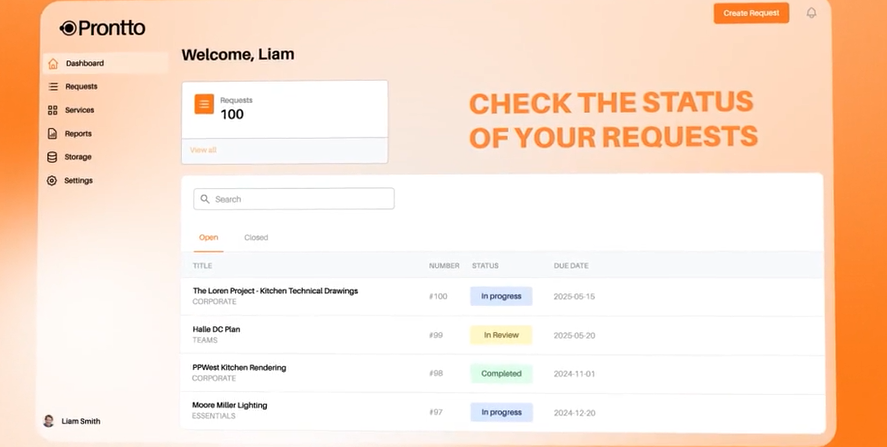
Look for a tool that lets you use your own domain, logo, and email notifications, without paying enterprise rates to remove the vendor's branding. Some portals call a feature "white-label" but only let you upload a logo while their name stays on your client's checkout page and notification emails.
For instance, here’s an example of a complete white label from one of ManyRequests’ clients, Prontto.
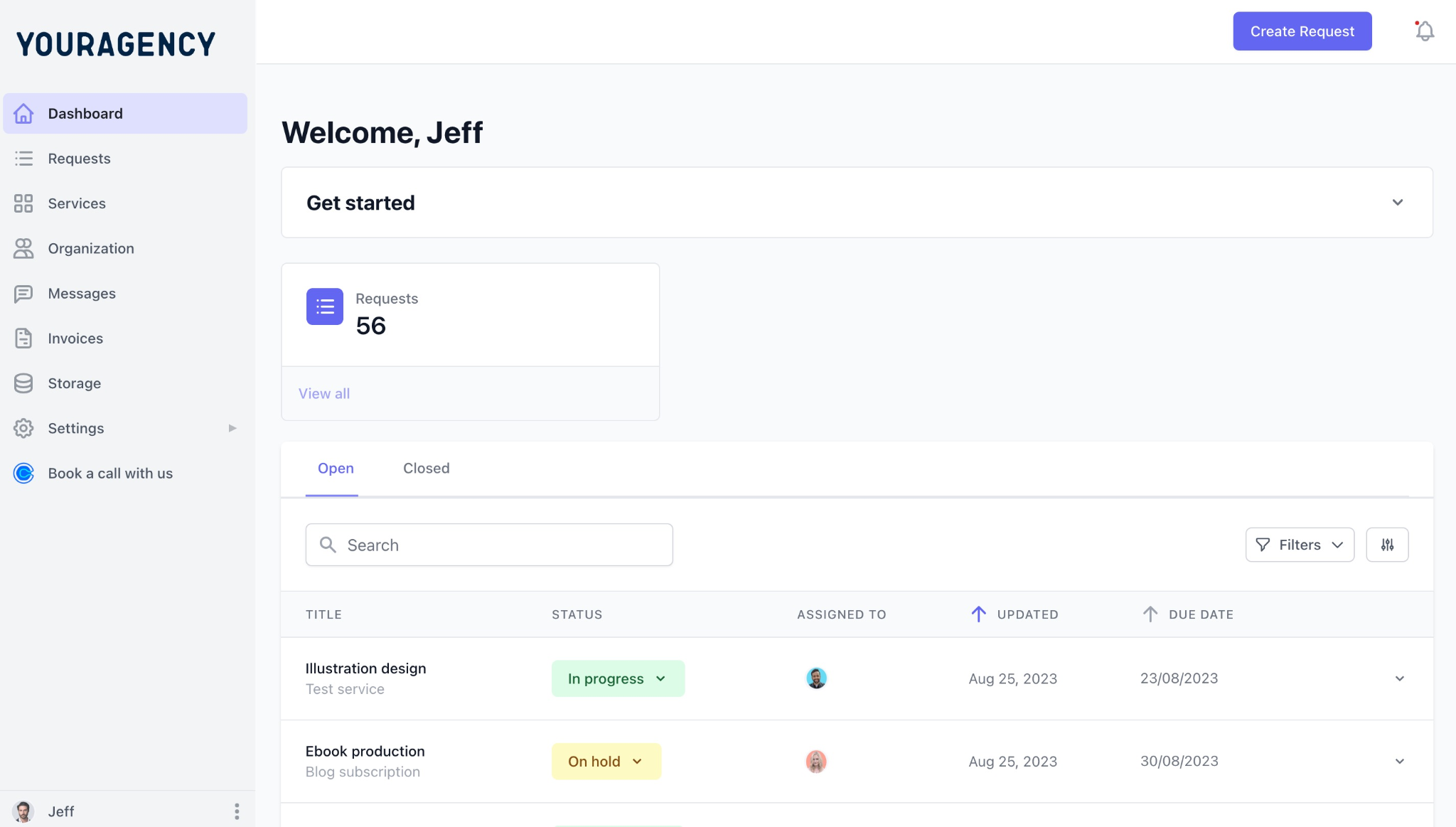
Compared to what ManyRequests’ branding looks like:
Your billing tool should handle retainers, hour bundles, credit-based plans, and automatic rollovers from the same platform, and not through a third-party integration. If your clients can't upgrade or downgrade their plan without emailing your team, that's a gap.
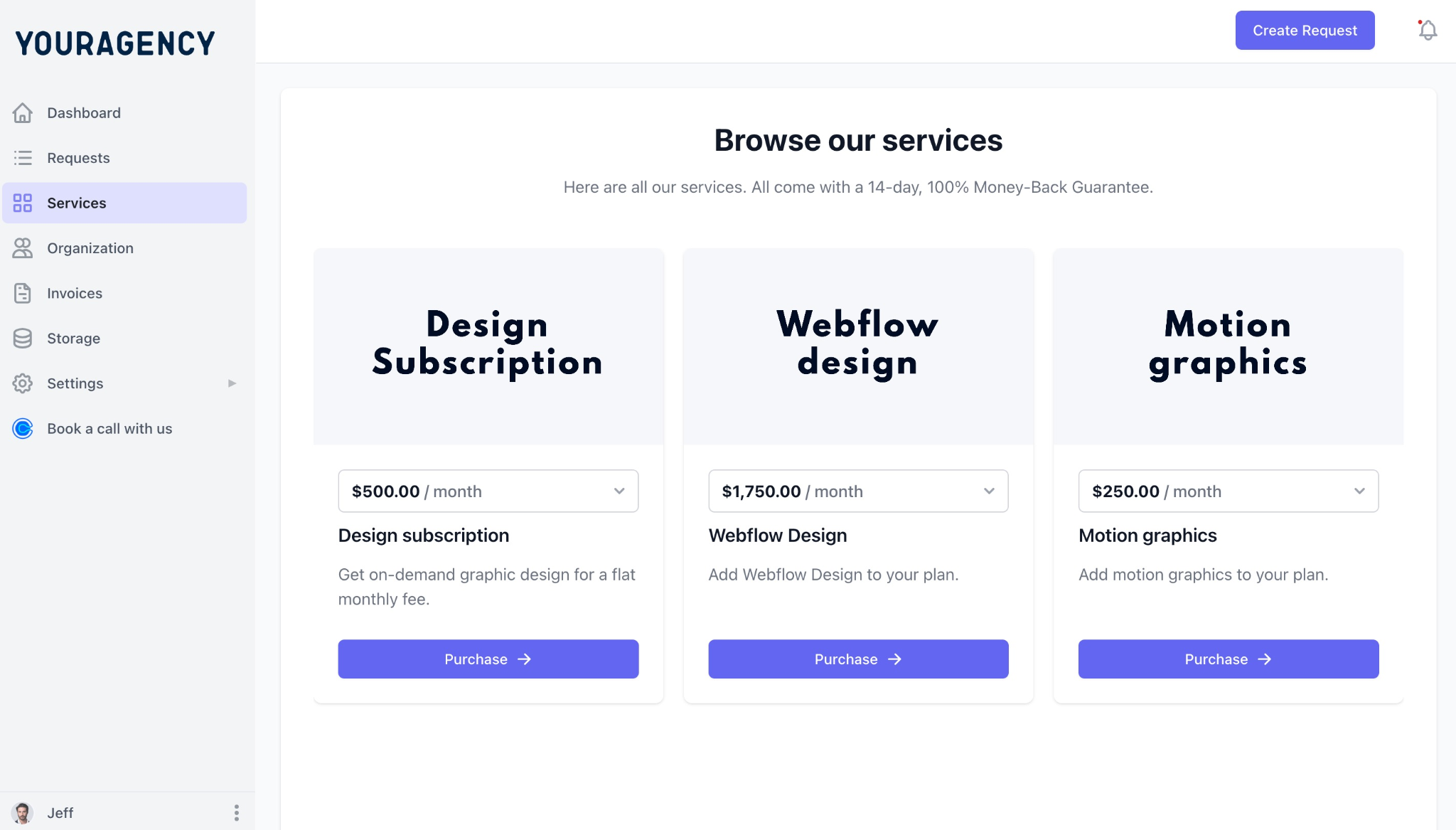
A service catalog lets prospects browse your packages, compare tiers, pay, and get onboarded automatically, without manual intervention from your team. If that flow requires manual intervention at any step, then it's not productized.
Here's an example of a service catalog from ManyRequests:
Look for a tool that lets you scale up and down based on your volume of users and transactions. Look for flat-fee pricing with no per-client caps. Your tool cost should scale with your team size, not your client roster. Assembly caps you at 50 clients on Starter and 500 on Professional before forcing an upgrade.
You can also check if it lets you link subscription plans together so your clients can upgrade to a different tier. If they bought service A, this flexibility lets them upgrade to service D (because they want the deliverables in service D and can afford it).
Here are my top 4 picks to consider for your agency. You can start with their free trials to see if they're the perfect fit before you commit to them.

ManyRequests is a client portal that helps you sell productized services, manage all service requests, assign tasks, and communicate with clients and teams directly. Unlike general project management tools, it has built-in markup features and automatically creates invoices to avoid administrative stress and reduce the risk of errors.
Best for: Productized agencies that want one platform for client portals, billing, and project delivery.
Let's look at some of its standout features as an Assembly alternative:
ManyRequests lets you completely redesign your client portal the way Prontto has done:
This brings your clients to a space that feels custom-built to handle all their requests and manage communications, invoices, and billing. You can use your custom domain name and rebrand the URL with your agency name. This is Teamtown using the client portal to manage their agency and billing needs:

The client portal allows customizable service request forms so you can collect task details every time your clients make a request. You can convert these task details into a brief so your assignee can know how best to meet client expectations. Your clients can also set due dates directly when they create the request form so you're both aligned.
You can also brand these service forms with your logo, share them via email or branded links, or embed them on your website as Teamtown does.
The latest update to ManyRequests now allows clients to create requests by simply sending an email.
Each workspace gets a dedicated email address, so when a client sends a message, the subject becomes the request title, the body becomes the description, and the sender is matched to their account automatically.
For retainer clients who don't want to log in every time they have work, this removes the friction entirely.
ManyRequests has transparent pricing designed for growing agencies. It starts at $59/month (Core) and goes up to $99/month (Pro). You can add extra seats for $20/month on Core and $30/month on Pro. All plans include unlimited clients (no client caps, no per-client fees).
It integrates with Stripe, so you can receive payment directly and set automated invoice reminders without subscribing to another invoicing and billing software.
Depending on how you structure your services, you can customize payment schedules with your clients (100% upfront, 50% upfront, or post-project). ManyRequests doesn't charge transaction fees, so you only pay Stripe fees directly.
You can also upsell clients with add-on services (with separate billing) without affecting your retainer services to that client.
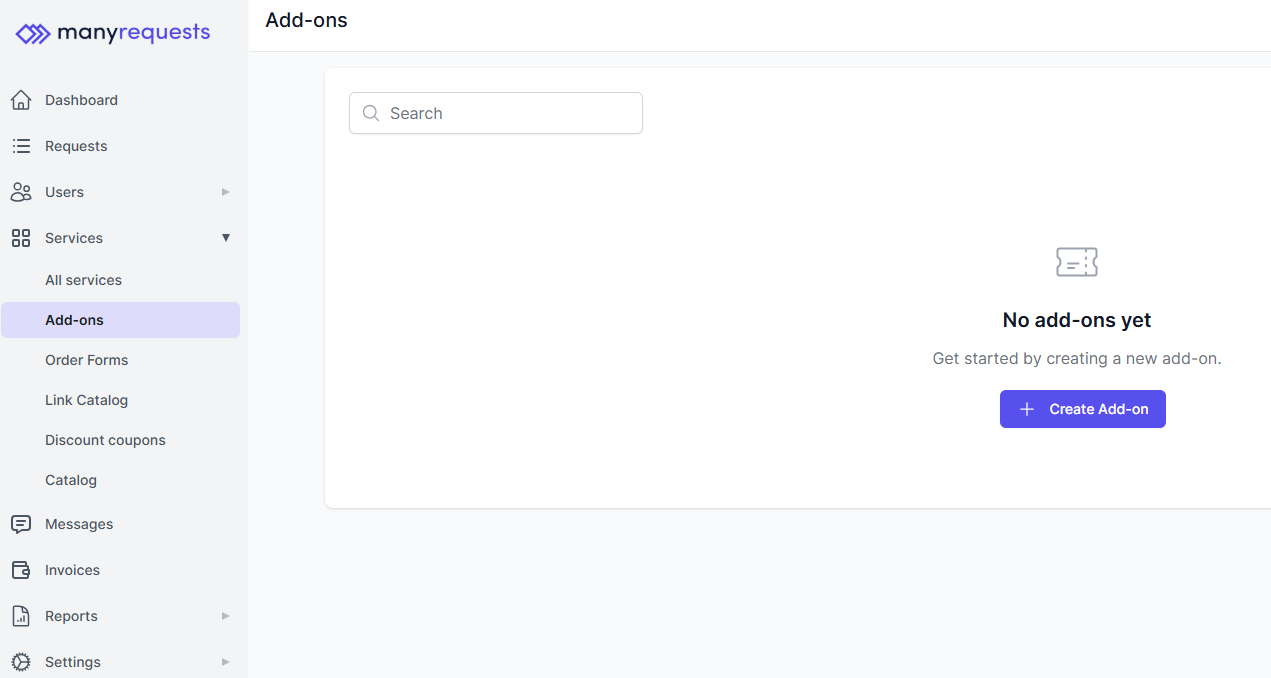
ManyRequests has project management features that automatically turn client requests into tasks, which you can assign directly to a team member.

The task box has multiple status options: "To Do, In Progress, Pending Feedback, Revisions Needed, Completed."

You can use the same task box to set deadlines, assign tasks to a team member, and indicate the priority level: “low, medium, high.”
You can filter requests using organization-level tags like "VIP" or "Enterprise" across lists, Kanban boards, and dashboards without needing to tag each request manually. This is useful if you manage multiple client tiers.

ManyRequests also has time-tracking features for hourly projects and an embedded CRM tool to manage client lifecycles. The reporting dashboard lets you filter by service, client, and team member to see which work is most profitable and where your team's time is going.
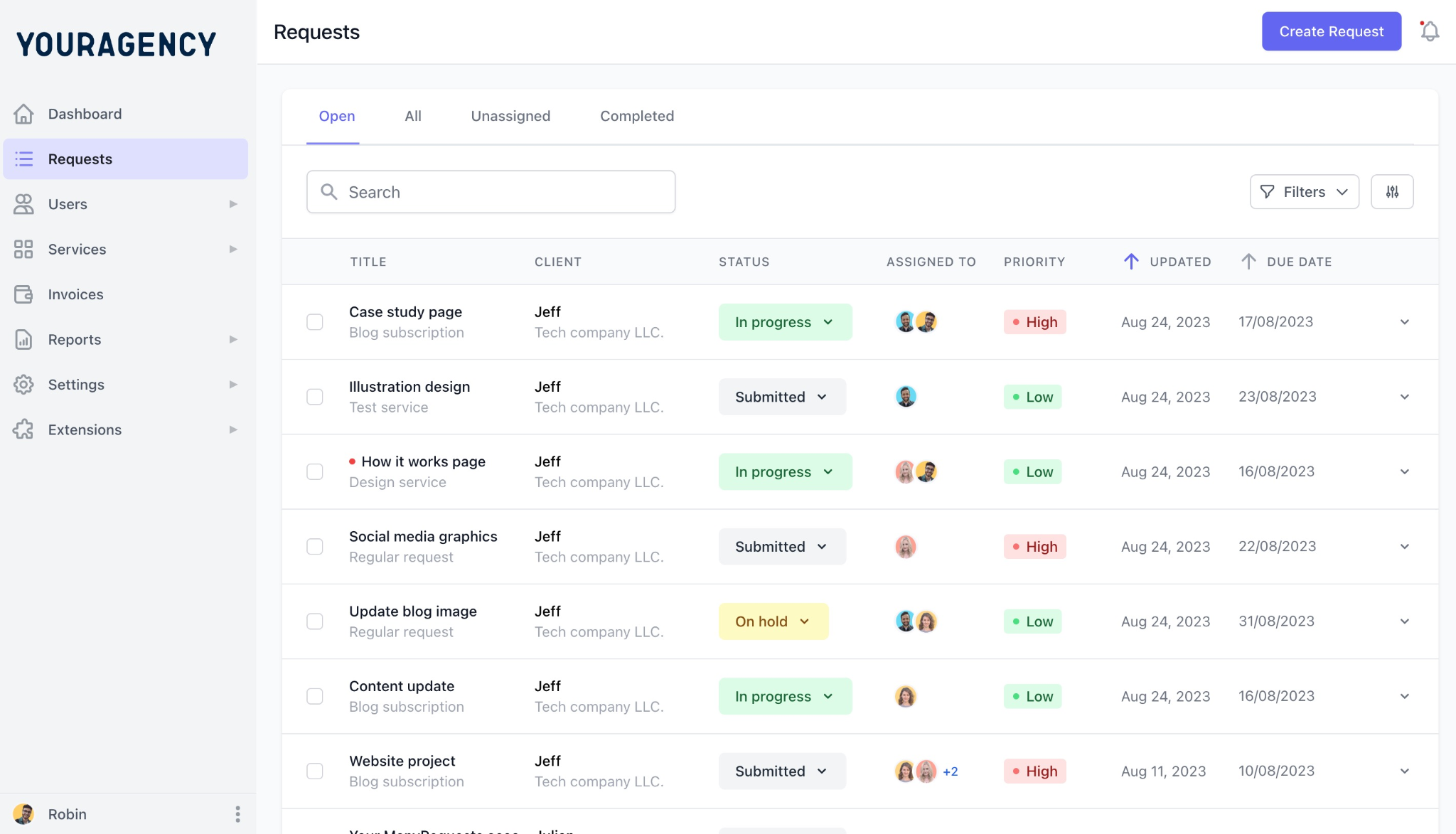
You can sign up for a 14-day free trial to see how ManyRequests works.

SuiteDash is an all-in-one business platform that combines CRM, project management, and client portal features into one solution.
Best for: Agencies that want a flat-fee pricing model with unlimited users and clients, and don't mind investing time in setup.
Key difference from Assembly: SuiteDash doesn't charge per user or per client. Its monthly fee stays flat whether you have one team member or ten, something Assembly can't match once you start adding internal users at $39/user on Professional. It also gives you full white-labeling including custom domain and CSS customization without jumping to an enterprise tier.
Let's take a look at how some of its features compare to Assembly:
SuiteDash lets you customize your portal with custom domains and remove SuiteDash branding entirely. You can modify the design with custom CSS and create client-specific dashboards.
Each client gets a unique login area to access invoices, contracts, and files. They can track project progress in real-time, submit support tickets, and use the self-service booking system.
SuiteDash has project management features with basic task assignments, time tracking, project automation, and Kanban views for all active tasks. It markets itself as all-in-one business software, and for the price, it comes close.
Where it falls short
SuiteDash doesn't have a service catalog or subscription-first billing built around the productized model. If you sell tiered service packages and need clients to browse, subscribe, and pay without involving your team, you'll hit limitations. It's also not built specifically for creative agencies, so there's no design proofing or annotation tool built in.

Teamwork started as a project management tool and is now one of the more established Assembly alternatives for agencies managing multiple client projects at once. It provides detailed project tracking and resource management features that Assembly doesn't offer at any tier.
Best for: Agencies running complex, multi-phase client projects that need Gantt charts, task dependencies, workload planning, and profitability reporting.
Key difference from Assembly: Teamwork goes significantly deeper on project management. Where Assembly handles client communication, contracts, and basic tasks, Teamwork adds milestone tracking, task dependencies, and profitability reports per project — giving you visibility into which clients and services are actually making money.
Teamwork allows white-labeling through custom domains, and you can give clients project-specific access to the portal. While it has limited customizations as a client portal because there's no onboarding system, you can use its client communication features to exchange conversations with your clients.
You can track billable hours directly inside Teamwork and link them to project budgets and profitability reports. It also has a Workload Planner to manage team capacity and identify overbooked members. For agencies looking for copilot alternatives with strong project delivery features, Teamwork covers ground that Assembly simply doesn't.
Where it falls short: Teamwork doesn't have built-in payment processing; you'll need a separate billing tool. It also lacks a design annotation feature, which might be a gap if you need clients to provide precise feedback on design projects directly inside the tool.
If you like how Teamwork works, but you need a better version, we compared Teamwork alternatives you can consider.
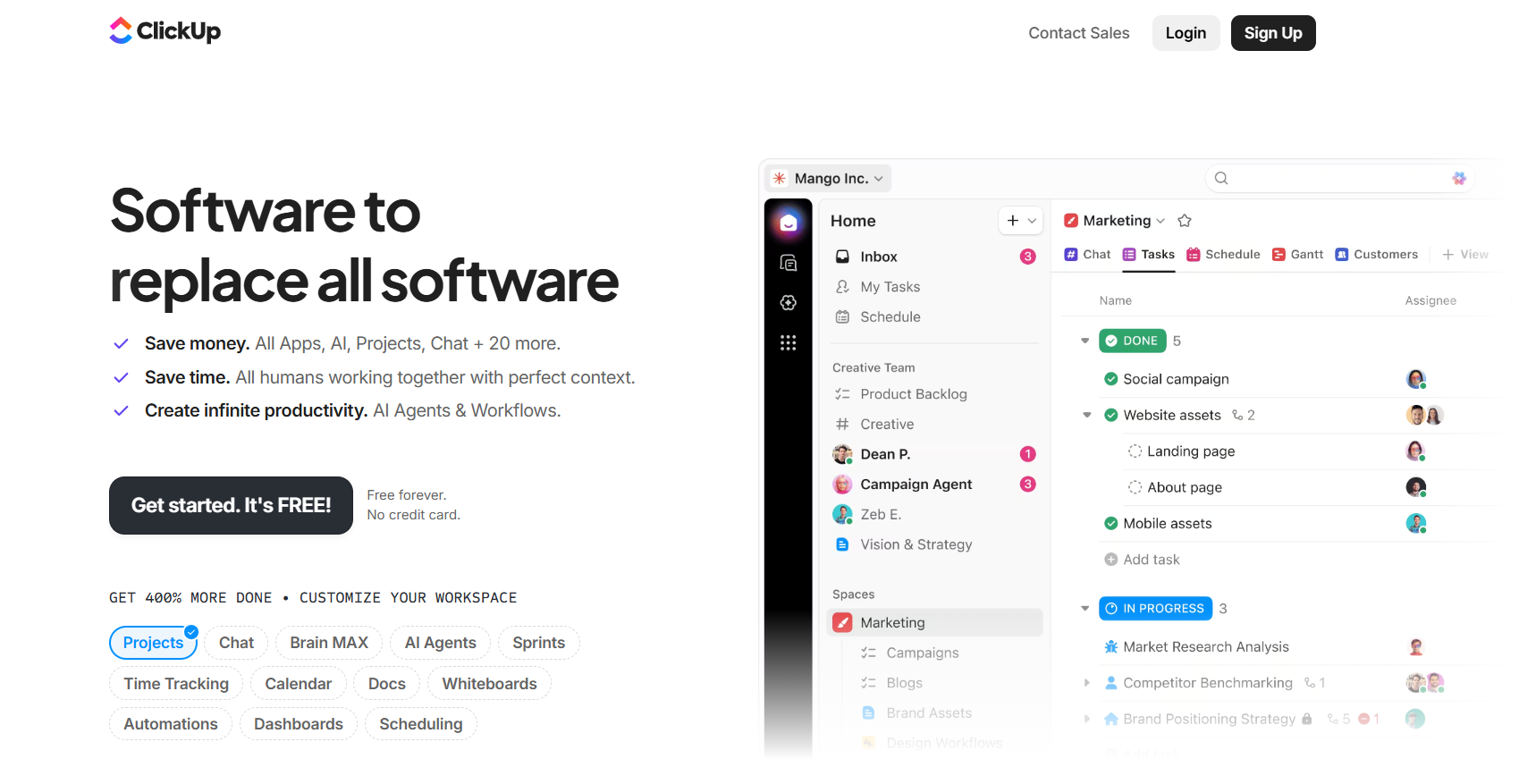
ClickUp is another Assembly alternative that positions itself as an all-in-one productivity platform for small creative teams and large agencies. It has different customization options but doesn't have the client management system some of its competitors have.
Best for: Agencies that prioritize internal project management and already handle client portals and billing through separate tools.
Key difference from Assembly: ClickUp has stronger project management features (custom statuses for design approval stages, proofing tools for images and documents, multiple task views, time tracking, and deep automation). The tradeoff is that it has no native client portal or payment processing, so you're still stitching together your client-facing workflow separately, which is something Assembly at least partially handles out of the box.
ClickUp's client portal is limited because clients are invited to your workspaces as guests. ClickUp has no white-labeling features, but you can create a specific page where your clients can view and comment on tasks, invoices (through QuickBooks integration), and contracts.

It doesn't have an automated client onboarding flow, so you must manually set up access for each new client.
It also doesn't have a native payment processor, so clients can't pay directly from your portal. While it's a strong copilot alternative for its productivity and project management features, you need additional subscriptions for invoice and billing management.
Where it falls short: ClickUp has custom statuses for design approval stages, proofing tools for images and documents, time tracking, and customization options. However, it takes time to set up. If you're not an automation power user or looking for a simple tool with a less cluttered UI, Clickup is not your best bet.
Comparison Table Between the Assembly Alternatives vs. Assembly.
If you knew this tool as Copilot, this comparison still applies, since it is still the same product, but with a new name.
Assembly and ManyRequests are both client portals. But they were built for different businesses, and that gap shows up the moment you try to run a productized agency on either one.
Let's compare some of its features:
Assembly gives you a custom domain on Professional ($149/month), but your clients still see Assembly's branding on their checkout page and notification emails until you're on Advanced ($399/month). That means your clients will still see "Powered by Assembly" on your checkout page, and not your agency name.
ManyRequests removes all third-party branding on the Pro plan ($99/month). Your clients log in, check out, and receive notifications under your brand at every touchpoint, which is $300/month less than Assembly's equivalent.
Assembly acts as the merchant of record. That means they are between you and your client's payment, and your transaction history, payment rates, and client billing data all live inside the system.
If you process $50,000/month through Assembly and decide to switch tools, you're not taking that payment history with you cleanly.
ManyRequests connects directly to your own Stripe account. You own the payment relationship, the transaction history, and the client data. You don't have to start over with your payment infrastructure if you switch tools.
Assembly handles invoicing and basic subscriptions, but it wasn't built around the recurring, package-based billing model that productized agencies run on. There's no hourly billing with automatic rollover, no credit-based plans, and no way to offer free or paid trials on your service packages.
ManyRequests handles retainers, hourly billing with automatic rollover, credit-based plans, free and paid trials, and one-time payments, all from the same platform. Your billing system works the way your services are structured, not the other way around.
Assembly has a store feature, but there's no clean browse-and-subscribe flow where a prospect can land on your catalog, compare your service tiers, pay, and get automatically onboarded without your team touching anything.
That means every new client signup still requires someone on your team to manually set up access, send onboarding information, and confirm the payment. That's a lot of manual traffic for a productized agency with a steady flow of news clients.
On ManyRequests, a prospect lands on your service catalog, browses your packages, pays, and gets automatically onboarded into your portal.

Your team shows up to a task that's already organized by the system.
Assembly has no built-in annotation tools. When a client needs to give feedback on a design or video, they're writing comments in the messaging thread, and your designer is interpreting vague descriptions instead of seeing exactly what the client means.
ManyRequests has built-in annotation tools for images, PDFs, and video.

Clients click directly on the area they want to change, leave a comment attached to that exact point, and can record a video explanation for complex revisions. Your designer opens the file and sees numbered, specific feedback tied to the exact frames and elements that need work.
Pricing
Assembly's entry price is lower, but the features productized agencies actually need (full white-labeling, unlimited clients, and subscription billing) are the expensive pricing plan. ManyRequests Pro at $99/month covers what Assembly charges $399/month for.
The best Assembly alternative for your agency depends on what you're trying to fix.
If your main frustration is project complexity (multiple stakeholders and task dependencies) Teamwork handles that better than Assembly. If you want a broad feature set at a flat monthly fee without per-user costs, SuiteDash is worth evaluating. If internal project management is your priority and you already manage client portals and billing separately, ClickUp gives you the customization and workflow depth Assembly doesn't.
But if you run a productized agency with recurring clients, subscription billing, and a team delivering work at volume, ManyRequests is the best Copilot alternatives on this list built specifically for that model.
You get a white-label portal, service catalog, subscription billing, design proofing, and project management, that makes it perfect for your agency to scale without increasing operational costs. Try ManyRequests free for 14 days, no credit card required. Or if you'd rather see it in action first, you can book a demo directly with the founder.
Yes. Copilot officially rebranded to Assembly in September 2025. The name changed because "Copilot" had become too closely associated with Microsoft and GitHub's AI tools, making the platform difficult to find through search.
It works well for small service businesses that need a clean client portal with messaging, contracts, and basic invoicing. For productized agencies running subscription-based services, the per-client pricing caps, limited subscription billing, lack of design proofing, and Assembly's merchant account model create too much friction.
ManyRequests. It's the only tool on this list built specifically for the productized agency model — white-label client portal, service catalog, subscription billing, and design proofing in one platform. Full white-labeling starts at $99/month, compared to Assembly's $399/month.
Both are client portals built for different businesses. ManyRequests connects directly to your Stripe account — you own the payment relationship. Assembly acts as the merchant. ManyRequests has built-in design and video proofing; Assembly has none. Full white-labeling on ManyRequests costs $99/month versus $399/month on Assembly.
Formerly written by Peace Akinwale
1. See how ManyRequests works in real life. Start a free trial and experience how productized agencies centralize requests, reduce chaos, and streamline delivery, without changing their entire workflow.
2. Read our Implementation Guide to launch smoothly with your team and clients.
3. Follow us on LinkedIn and YouTube for practical agency growth strategies
4. Check out The Productize Blueprint to learn how to turn your services into a scalable, productized offer.
Adetola Rachael Iyanuoluwa is a B2B SaaS writer and content marketer with 4+ years of experience creating SEO, human-focused content. She writes in-depth how-to guides and comparison articles content that help SaaS companies grow organic traffic and turn readers into customers. At ManyRequests, she produces practical, well-researched content that helps agencies and service businesses streamline operations and scale sustainably.