Agency Recurring Revenue for Productized Agencies (2026)
Agency recurring revenue for productized agencies, learn how to structure services, pricing, and delivery systems that scale.

William Nzewi
.jpg)
Agency recurring revenue comes from retainers, subscriptions, or productized services, but it only works when delivery, pricing, and communication are structured properly.
This guide gives you everything you need to set up and earn recurring revenue as an agency.
It breaks down how agency recurring revenue actually works, including how to package your services, choose the right model, and build the workflows, client portal and delivery system needed to make it sustainable.

Agency recurring revenue works when your service and delivery are structured in a way your team can easily repeat every week.
Most agencies have tried the retainer and subscription models with minimal success because they lacked a proven system.
It's not really hard if you adopt this simple framework:
Everything in this guide maps back to these six parts.
Recurring revenue, for agencies, starts with clarity.
If your service changes for every client, you can't deliver it on a monthly basis. Productizing means turning your service into a defined offer with a clear outcome.
Instead of saying: “We do design, and branding”
You say: “Unlimited design requests with 72-hour turnaround”
or “5 SEO articles per month”.
This shift does two things:
This is the foundation of a productized agency revenue model.
If clients don't know what is included, they'll ask for anything. If your team doesn't know the limits, they will overdeliver and burn out.
You therefore need to define:
For example:
“Up to 3 active design tasks at a time”
“72-hour turnaround per task”-
There are 3 common options in agency recurring revenue:
Fixed retainer
A set monthly fee for a defined scope
Subscription model
Ongoing access to a service, often request-based.
Productized packages
Fixed deliverables each month.
The mistake most agencies make is picking a pricing model first, then trying to force delivery into it.
Work the other way instead:
Then price based on that.
Recurring revenue only works if your delivery is repeatable. That means every task should follow a clear process. Not something your team has to figure out each time.
A design request workflow might look like this:
This should be the same for every client.
You can create simple Standard Operating Procedures (SOPs) for:
Repeatable workflows reduce errors and speed up delivery. This allows agencies to move from unpredictable projects to stable monthly revenue.
This is one of the biggest reasons recurring revenue fails in agencies.
When requests come through different channels (email, Slack, WhatsApp, calls), things are likely to go missing. Work becomes messy. Your team spends more time tracking information than doing actual work.
You need one place where:
A solid client portal takes care of this.
Platforms like ManyRequests give you a structured way to manage this. Clients log in, submit requests, track progress and communicate with your team without switching tools.
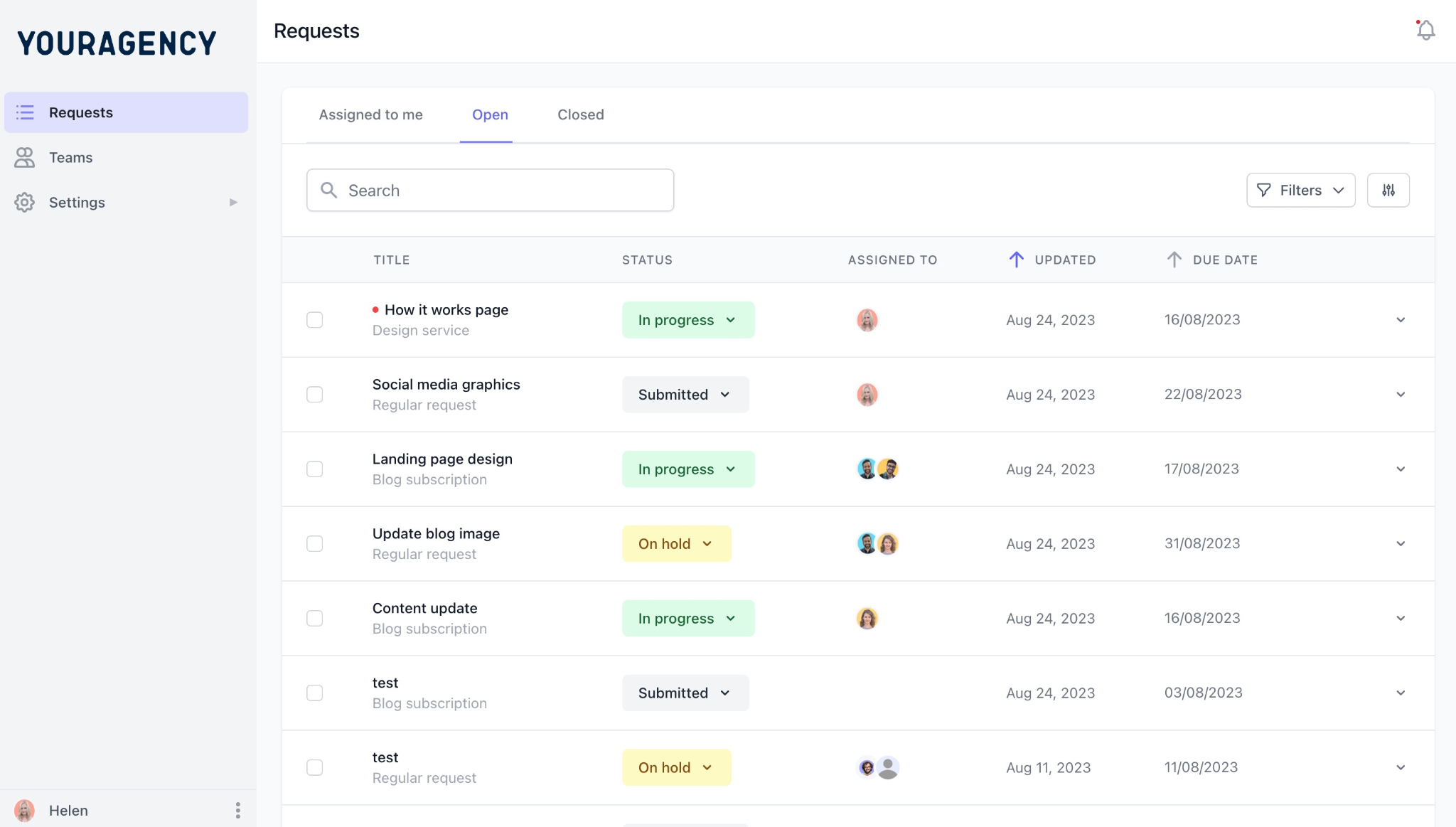
ManyRequests: request (client view)
You need:
This does two things:
When billing is tied to your service structure, everything becomes smoother.
Instead of sending invoices every month and bothering clients over payments, your revenue becomes predictable.
Each part of this system supports the others:
If one part is missing, the system breaks.
For example:
Many agencies struggle with recurring revenue. They try one piece (like retainers) without building the system around it.
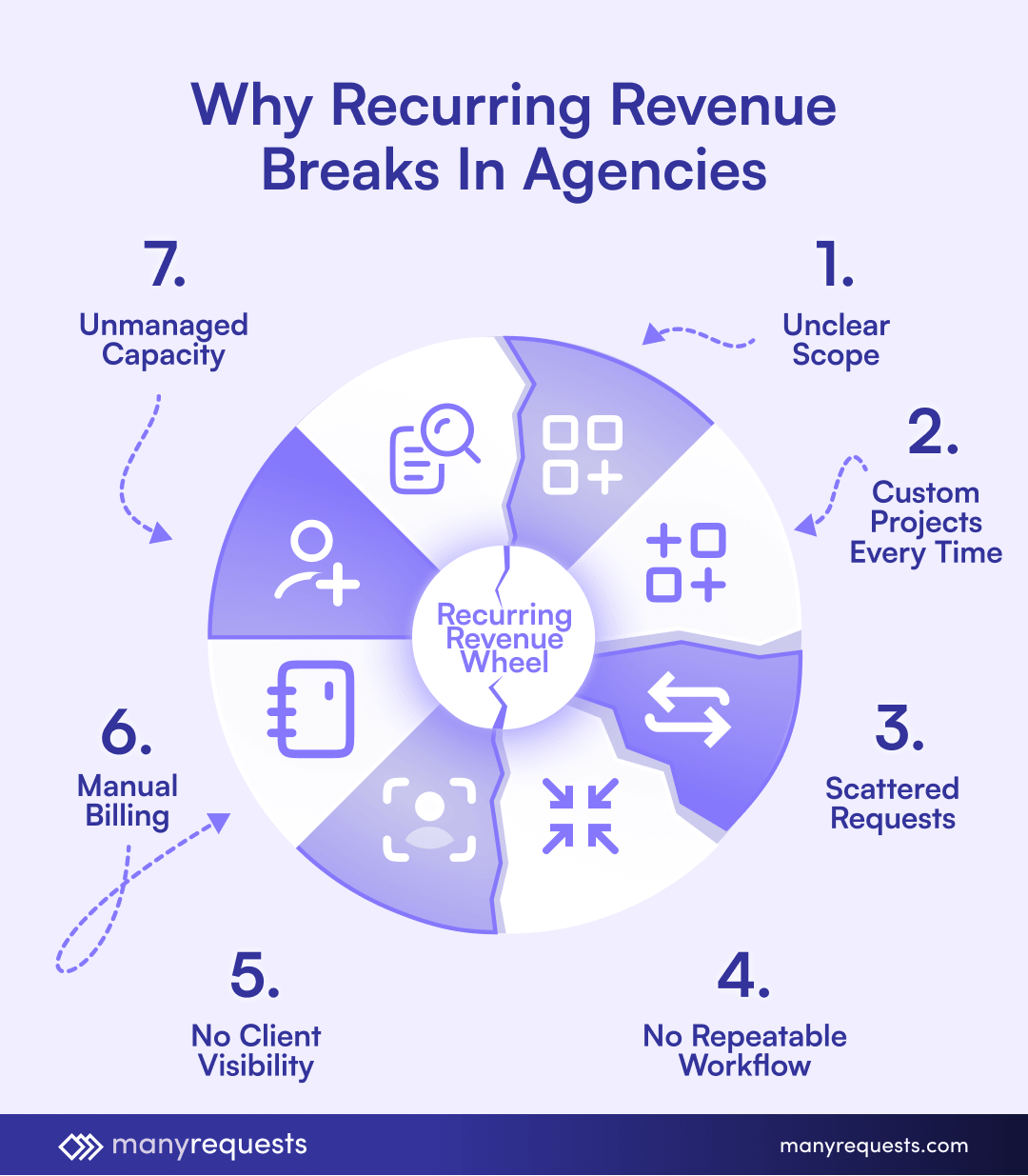
Recurring revenue for agencies sounds simple. Charge monthly and deliver ongoing work.
But in practice, many agencies try it and run into the same problems. Retainers become stressful. Clients ask for too much. Teams get overwhelmed.
Is the model wrong? Not at all. The issue is how it's set up and delivered.
Here are the main reasons agency recurring revenue breaks.
Agencies say things like:
“Ongoing design support”
“Monthly marketing services”
But they never clearly define what that means.
So clients assume unlimited work and fast turnaround. Anything they need is included.
Over time, each client becomes a different version of the service. Your team cannot keep up because there's no fixed scope.
This is where most agency retainer revenue fails. Without clear limits, every month will seem like a new project.
Recurring revenue only works when your service is repeatable. But many agencies keep customizing their process for each client. Different workflows and different deliverables, all to accommodate clients with different expectations.
To keep up, your team has to relearn how to deliver the service every time. There's no consistency and no clear system.
This makes it hard to scale.
Clients send work through email, Slack, WhatsApp, voice notes, even random calls. There's no single place to track requests.
What happens next?
This creates stress on both sides.
Recurring revenue depends on steady delivery. Scattered requests will only make it chaotic.
Even when scope is defined, many agencies don't have a clear process for how work gets done. No one really knows who handles what or what the next steps are.
This results in delays and inconsistent quality. Without repeatable workflows, your team can't handle ongoing work efficiently. Recurring revenue needs a system which works the same way every time.
Clients expect clarity but many agencies leave clients in the dark. No clear task status and timeline. No easy way to check progress.
This leaves clients asking for updates or when their project will be delivered.
Then your team spends time answering questions instead of doing the work.
Recurring revenue should be predictable.
But many agencies still send invoices manually or forget to bill on time and end up pursuing late payments.
Even if your service is solid, your revenue becomes unreliable because the billing process is weak.
Automatic billing is one of the pillars of recurring income. Without it, you're essentially running a project-based system.
Many agencies keep adding retainer clients without thinking about workload.
Over time, it impacts turnaround times and quantity. And your team burns out from overload.
Recurring revenue involves knowing how much work your team can handle.
When these issues stack up, the model breaks:

If you want stable agency recurring revenue, you need more than monthly pricing. You need a service your team can deliver the same way every time.
Hence the productized model.
I don't mean custom services. A productized model sells clearly defined offers with fixed scope and clear outcomes delivered in a repeatable form.
Productizing your service means turning it into something predictable.
“We handle your marketing” or “We do design and branding” won't fly.
Instead you define the offer like this:
“Unlimited design requests with 36-hour turnaround”
“7 SEO blog posts per month”
“Monthly website maintenance and updates”
Notice what these offers have in common?
A clear scope and a clear output. Clients know what they're getting. Your team also knows what to deliver.
Recurring revenue depends on consistency. If your service changes every month, your revenue might be recurring, but your operations are not. That creates stress and unpredictable margins.
Productization fixes this by making your service:
Your team does the same type of work again and again. This builds speed and reduces errors.
You know how long tasks take and how much capacity you have. This makes pricing more accurate.
Clear offers are easier for clients to understand. They don't need long calls to figure out what you do.
You can add more clients without changing how your team works.
This makes the subscription agency model sustainable.
Most successful agencies with recurring revenue follow this model, even if they don't call it that.
Here are common examples.
Website Maintenance Plans
In all these cases, the service is structured. It's not different for every client.
Many agencies try to build recurring revenue without changing how they work.
They keep offering custom solutions and adjusting scope per client while changing deliverables every month.
Then they add a monthly fee on top.
This creates avoidable problems:
One of the biggest benefits of productizing your service is that it forces you to make decisions.
You have to answer:
This clarity improves everything: sales conversations, onboarding, delivery, client expectations.
The subscription agency model works best when clients can pay monthly and get consistent output.
Productization makes this possible because requests fit into defined categories and tasks follow a standard workflow. Turnaround times are also predictable.
You can't productize your service without setting boundaries. You have to limit the number of active tasks and define turnaround times. You have to restrict certain types of work.
This is the only way to make the service work.
Now, once your service is productized, you need a system to support it.
Clients need a simple way to submit requests, track progress and give feedback.
Your team needs a clear view of:
A platform like ManyRequests acts as the delivery layer for your productized service where:
This keeps your productized model running smoothly.
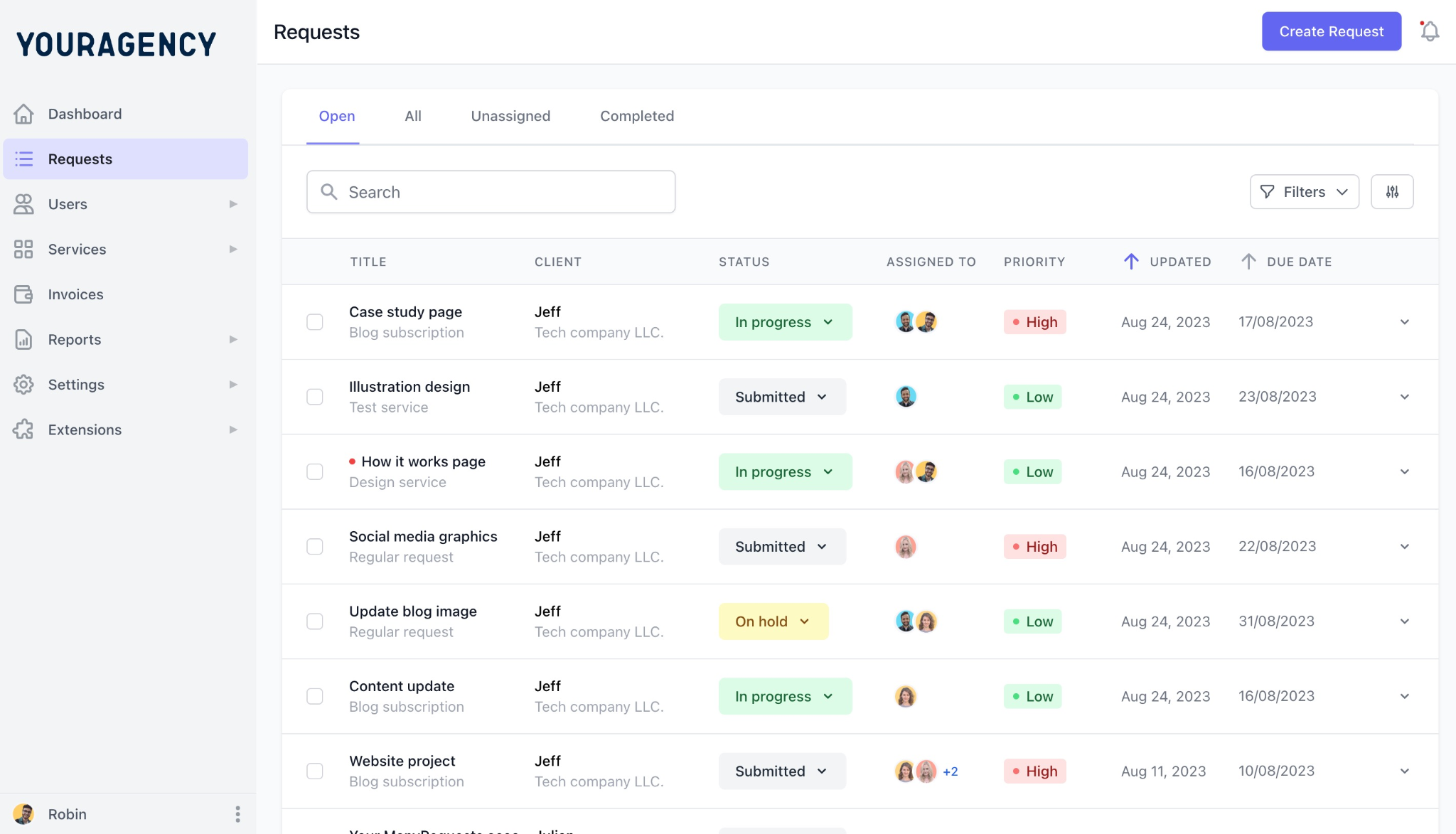
ManyRequest: request (admin view)
Let's discuss the 3 main recurring revenue models.
The retainer model is the most common form of agency recurring revenue.
Clients pay a fixed monthly fee. In return, you deliver ongoing services over time.
On paper, it's simple. In practice, it's not.
It won't work if you get the structure wrong.
The client pays monthly for continued access to your service.
Common examples:
The key idea is ongoing work, not one-time delivery.
Many agencies get this wrong because they treat retainers like open-ended projects.
There are 2 main ways agencies structure them.
1. Time-Based Retainers
Clients pay for a set number of hours each month.
Example: 45 hours of design work per month.
Sounds simple but it comes with issues:
You might end up selling time, not outcomes.
2. Scope-Based Retainers (Recommended)
Clients pay for a defined set of services or deliverables.
Example:
6 blog posts per month
Up to 4 active design tasks at a time
This model works better because expectations are clear and delivery is predictable.
Most strong agency retainer revenue is built on scope, not hours.
A strong retainer model is built on structure.
Here's what that looks like.
Define exactly what's included:
Also define what's not included.
Every task should follow a consistent workflow.
For example:
1. Request submitted
2. Task reviewed
3. Work in progress
4. Delivered
5. Revisions handled
This keeps delivery predictable across all clients.
Clients should not send work through random channels. They need one place to submit requests, monitor progress and give feedback.
Tools like ManyRequests make this easy. They give you a client portal where all requests and communication live in one place.
Your pricing should reflect how much work you can deliver.
Ask:
Then price your retainer based on that capacity.
What will a well-structured retainer look like?
Instead of “Monthly design support”, for example, you offer:
Clear and repeatable.
Now, what services fit the retainer model?
Retainers work best when the service is ongoing and repeatable.
Examples:
Remember, if you currently do custom work, you need to productize it first before putting it on a retainer.
Are retainers the same as subscription? Both models are similar but not the same.
Retainers are often tied to defined scope or deliverables. Subscription models focus more on ongoing access and request-based.
Let's look at this next.
Instead of paying for a fixed list of deliverables, clients pay for ongoing access to your service.
This model, common in productized agencies, works best when your service is structured around requests.
In a subscription model, clients pay a monthly fee, then:
A common example is a design subscription:
Other examples:
Clients buy access to your team within clear limits.
Retainers are usually tied to fixed deliverables and a defined scope each month. Subscriptions are tied to ongoing access and request-based delivery.
For example:
Retainer:
“5 blog posts per month”
Subscription:
“Submit content requests anytime. We handle them one at a time with a 3-day turnaround”
Both offer recurring revenue for agencies. The difference is how work is structured.
Here's why this model works…
Flexible for Clients, Controlled for You
Clients can submit different types of requests over time.
But you stay in control because:
Predictable Workload
Even though requests vary, your workload stays stable.
Why?
Because you control:
Easier to Scale
Once your system is set up, you can add more clients without changing how you work. Each new client fits into the same structure:
Clear Value for Clients
Clients see ongoing progress.
They submit requests and can see tasks being completed. This makes the service active and valuable every month.
An example of a subscription offer?
This is clear and easy to manage.
The subscription model works best when:
This includes design, content, video editing and website updates.
Here, you define exactly what the client gets each month and deliver it the same way every time.
There's no open-ended work and back-and-forth about scope.
In this model, each plan includes a fixed set of deliverables.
Examples:
Content package
SEO package
Design package
Website maintenance package
Each package is clear and structured.
Productized packages sit between retainers and subscriptions. Retainers often seem open-ended. Subscriptions focus on request-based access. Productized packages focus on fixed output.
In simple terms:
Retainer = ongoing support
Subscription = ongoing access
Productized package = fixed monthly deliverables
This makes productized packages easier to understand, especially for new clients.
Even though this model is simple, it can still fail if not set up properly.
Too Much Included
Agencies often try to make packages more attractive by adding too much.
This leads to:
Vague Deliverables
If your package isn't specific, clients will still ask for extra work.
For example: “Content support” is vague.
“5 SEO articles per month” is clear.
No Delivery System
Even with fixed deliverables, you still need a process.
Without it, tasks will be delayed and quality will plummet.
A package without a workflow is still unstable.
Poor Communication Setup
Delivery slows down if clients can't easily submit input and give feedback.
You need a clear system for communication.
To make this model successful, you need structure behind the offer.
Defined Deliverables
Be specific about quantity and type of work and deadlines.
Example: “6 blog posts per month, delivered weekly, 1,500 words each”
Clear Process
Each deliverable should follow the same steps.
For example:
1. Topic approval
2. Content creation
3. Internal review
4. Delivery
5. Revisions
Standardized Onboarding
Every client should go through the same setup:
Centralized Communication
Clients need one place to submit information and review deliverables, giving feedback.
ManyRequests helps here. It provides a client portal where everything is organized.
Aligned Capacity
You need to know how much work your team can handle.
For example:
Then build your packages around that.
One solid way to structure a strong productized package should be like this:
This model works best when your service can be broken into repeatable deliverables and output can be clearly defined. Also, delivery has to follow a standard process.
It's especially strong for:
Use this table to identify which recurring revenue model best fits your agency's service type and team capacity.
Note: All three models require a centralized client portal for request handling, delivery workflows, client management, and billing.
Most agencies say they offer retainers, but what they actually sell is open-ended work with a monthly price. That leads to scope creep and unstable delivery.
Predictable monthly retainers come from structured packaging.
Here is a simple way to do it.
Start by focusing on one clear outcome.
Avoid broad offers.
They're hard to deliver on a monthly basis because they cover too many things.
Instead, narrow it down:
The more focused your service, the easier it is to package and repeat.
Once your service is clear, break it into repeatable units.
Ask:
What does the client get each month?
What does one “unit” of work look like?
Examples:
This helps you move from vague services to defined deliverables.
It also makes it easier to plan your team’s workload.
Define:
Also be clear about exclusions such as large projects and complex work outside the plan.
There are a few ways to structure your retainers.
Pick the one that matches your service.
Clear monthly output. Best for content, SEO.
Example: “5 articles per month”
Clients submit requests. Limited number of active tasks.
Example: “Unlimited requests, 3 active at a time”
Fixed deliverables plus request-based work.
Example: “5 articles per month plus ongoing updates”
Don't mix everything together. Keep your structure simple and easy to understand.
Most agencies should not have just one retainer.
Create 2 to 3 tiers based on volume of work or speed of delivery.
For example:
Basic
2 tasks at a time
Standard turnaround
Standard
3 tasks at a time
Faster turnaround
Premium
4+ tasks or priority delivery
Your pricing should reflect how much work your team can handle.
Start with:
Then set pricing based on that.
If you price too low, your team gets overloaded. If you price too high without clear value, clients hesitate.
Every client should go through the same setup process.
This includes:
A strong onboarding process sets expectations early and helps clients get value faster.
Even with good packaging, things break if delivery is messy.
It's best to use a client portal where:
This keeps your retainers structured and easy to manage.
Before a client signs, they should understand:
If expectations are unclear, problems will show up later.
Recurring revenue only works if your team can deliver the work every week without stress. So don't fix pricing and packaging, then ignore operations.
The ops layer is what turns recurring revenue into something your team can actually sustain.
All work must come through one place.
No email. No Slack messages. Also keep random calls away.
Use a single system where clients submit requests.
Each request should include a clear description and the necessary files (or links) .
ManyRequests is built for this.
Once requests come in, they need to be organized. The best way to do this is with a queue.
Instead of trying to do everything at once, you limit active tasks and the rest wait in line.
For example, 3 active tasks per client while all other requests sit in the queue.
This does two things:
Your team always knows what to work on next. Clients know their work will be handled in order.
Every task should follow the same process. Without this, your team will have to think through each task from scratch. This will slow you down.
A simple workflow might look like:
1. Request submitted
2. Task reviewed
3. Work in progress
4. Internal check
5. Delivered
6. Revisions handled
This should not change from client to client.
You can create basic SOPs for:
This will allow you to handle more clients without adding stress.
Every task should have one owner.
The owner is responsible for moving the task forward (updating status) and delivering the work.
This doesn't mean they do everything themselves. It just means they're accountable.
Your team needs clear timelines.
Without this, tasks drag on and priorities shift randomly. And clients keep asking for updates.
So set standard turnaround times for each task type.
For example,
Simple design task: 36 hours
Blog post: 2 to 4 days
These timelines should be realistic based on your team’s capacity.
Many agencies keep adding clients without thinking about how much work the team can handle.
You need to know how many tasks your team can complete per week and how many clients you can support.
Then set limits based on that.
Clients want to know what's happening.
If they can't see progress, they'll ask.
These constant messages and status update calls will slow you down.
Instead, give clients visibility inside your system.
They should be able to see their requests and review work. Like I stated above, a client portal is your best friend.
For example, with ManyRequests’ portal, clients can log in and see everything without bothering your team.
Communication should be tied to tasks.
So keep all communication inside each request.
This makes feedback easy to find and maintains context.
Your system should work the same way for every client.
Same:
This makes recurring revenue scalable.
If every client is handled differently, your operations will become messy again.
Client portals and intake systems are a core part of how a productized or subscription-based agency runs.
In a project-based setup, you can manage things with email and calls. There's a clear start and end.
Recurring work is different.
Clients are sending requests every week. Tasks are always in motion.
If you don't have structure, requests will pile up. Over time, this breaks your system.
A client portal and intake system give you a single place to manage everything.
A client portal is where the entire working relationship happens. First, it's how work enters your agency. Instead of clients sending random messages, they submit requests through a structured form or portal along with files or links.
Your team gets everything they need from the start.
In addition to submitting requests, clients can also:
Everything is in one place.
Clients don't have to bug you with constant follow-ups. There's no need for long email threads or status update calls.
It gives clients clarity without extra effort from your team.
Clients submit requests easily in a structured way. They can attach the necessary files with clear instructions.
Clients can see what's in progress and what's finished.
All messages are tied to tasks. This keeps context clear and easy to follow.
Clients are able to upload files and download deliverables.
ManyRequests does all of the above. It combines:
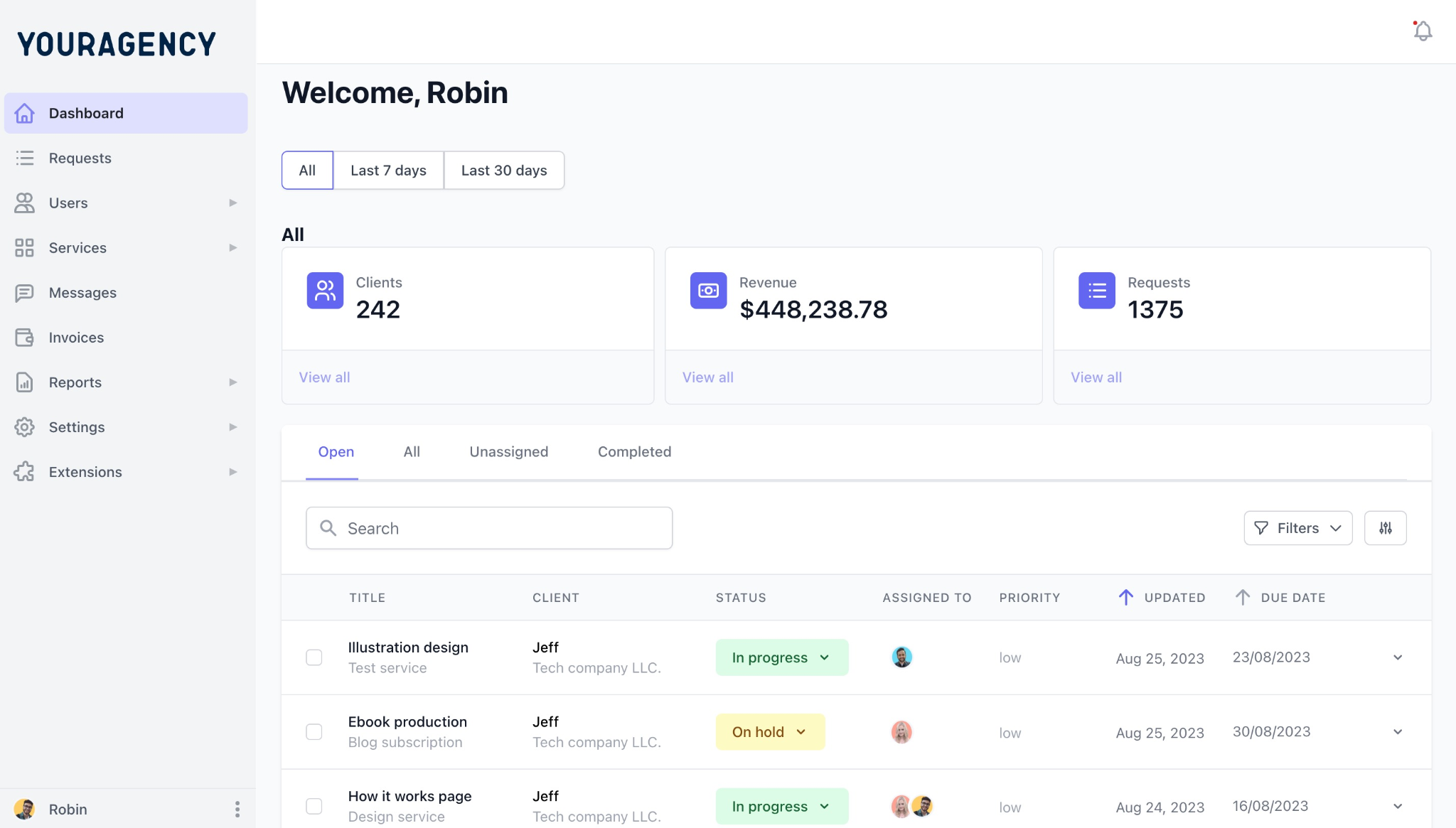
ManyReequests client portal (admin view)
A strong intake and portal system directly improves your operations.
It helps you:
This allows you to handle more clients with ease.
It also improves the client experience.
Clients feel informed and confident in your process. And this leads to better retention, which is key for recurring revenue.
You want to increase monthly revenue without increasing chaos.
That only happens when pricing and delivery are aligned.
Most agencies price based on what competitors charge or what feels right.
That’s risky.
You should price based on how your service is delivered.
For example: If one design task takes 2 hours, and a designer works 40 hours per week, that is about 20 tasks per week.
If each client gets 2 active tasks, you can estimate how many clients you can handle without overload.
This gives you a clear base for pricing.
Value-based pricing is important, but it shouldn't ignore capacity.
If you underprice, you attract too many clients. Then your team gets overwhelmed and delivery slows down.
If you overprice without clear structure, clients hesitate and sales slow down.
Here's the sweet spot:
Price based on the value you deliver but stay within what your team can handle.
Instead of one plan, offer 2 to 3 options. Something like this…
Basic
1 active task, standard turnaround.
Standard
2 active tasks, faster turnaround.
Premium
3+ active tasks, priority delivery.
Scaling doesn't always mean getting more clients. In many cases, it's easier to grow revenue from existing clients.
You can do this by:
Clients who see value are often willing to upgrade. This increases revenue without adding new workload complexity.
You can offer extra services outside the main plan: extra design tasks and additional content pieces.
If a client needs more work, you can expand their plan. But this should always be structured.
Don't just “add more work” without adjusting pricing or limits.
One of the biggest mistakes agencies make is growing too fast.
They keep signing clients without checking if the team can handle the workload.
Set clear limits:
When you reach your limit, you either raise prices or hire more team members.
At some point, you will need to increase prices. This is normal.
So consider raising prices when demand is high and your team is at capacity.
When you raise prices:
To scale recurring revenue, you need to track a few key numbers:
These will help you see if you're growing.
As your agency grows, manual processes stop working. You'll need systems that support your model.
This includes:
With a platform like ManyRequests, you're able to:
This reduces admin work and keeps your operations clean as you scale.
Agency recurring revenue works when your service and delivery are structured, and communication is seamless.
The retainer, subscription and productized package models all need a system your team can repeat every week.
When your scope and your workflows are defined, and your requests are managed in one place, recurring revenue becomes stable.
ManyRequests' client portal provides an all-in-one environment which makes all of this possible.
Try ManyRequests for free today.
Agencies build recurring revenue by turning their services into structured, repeatable offers that clients pay for monthly.
The best retainer model is scope-based, not time-based. Time-based retainers (charging for hours) are harder to manage.
Productized agencies usually charge through monthly subscriptions or fixed service packages.
Agencies need tools that support structured delivery.
A solid client portal handles requests management, communication, task management and automation billing.
Set firm boundaries upfront. Define what's included and what's not. Limit the amount of work (tasks or deliverables) and set turnaround times.
Neither model is always better. It depends on your service. Retainers work well for fixed deliverables or ongoing structured work. Subscription models work better for request-based services with flexible needs.
1. See how ManyRequests works in real life. Start a free trial and experience how productized agencies centralize requests, reduce chaos, and streamline delivery, without changing their entire workflow.
2. Read our Implementation Guide to launch smoothly with your team and clients.
3. Follow us on LinkedIn and YouTube for practical agency growth strategies
4. Check out The Productize Blueprint to learn how to turn your services into a scalable, productized offer.
William Nzewi is a data scientist and a writer. He likes to read and learn new things, especially about tech, business and life.