Free Project Management Proposal Template [Docs / DOCX]
A project management proposal template for creative agencies needs eight sections: a cover page, project overview, closed scope, phased timeline, revision policy, client responsibilities, payment schedule, and terms. Most online templates skip at least three of those. That's where projects start losing money.
If you're running a creative agency and your last project ran over scope, over budget, or over timeline, this is for you. This guide walks through each section and shows you exactly what goes in each one. Free template at the end.
Why your current proposal template isn't built for project work
The mistake isn't laziness. It's that nobody told you the template needed to change when the engagement type changed. That's the difference between a project that runs cleanly and one that bleeds scope for three months.
What goes in a project management proposal template for creative agencies
Each section has a job. Don't skip any of them and don't combine them.
The cover page is where your client forms their first opinion
Without a cover page, your proposal has no context. The client opens it and has to figure out what they're looking at before they've read a single word.
Skip the cover page, and you've already started on the wrong foot.
Five things go on the cover. Each one has a specific job:
- Your agency name and logo, so they know immediately who sent it
- Your client's name and company, so it feels like it was written for them specifically
- The date so both sides have a clear reference point if the proposal comes up later
- The project title sets the scope clearly on the first page
- One line describing the engagement so they know exactly what they're about to read
For a project management proposal, the project title should include the deliverables and the timeline. Something like: "Brand Identity Project — 35-day engagement." That tells your client right away this is a fixed engagement with a finish line, not an open-ended relationship.
A blank document with a generic header tells your client one thing: this agency treats proposals as paperwork, not presentation.
The project overview is not about your agency
The scope and pricing land without any context for why the project exists.
Fix that with one short paragraph at the top. Here's what a weak project overview looks like:
"Before the first brief opens, this document answers every question [Client Name] should be asking. Our agency has years of experience delivering high-quality creative work for clients across industries."
Here's what a strong one looks like:
"What [Client Name] shows the market right now is a version of the business they've already moved past. Competitors with stronger visual identities are winning deals they should be losing. This project delivers a complete brand identity system that positions [Client Name] where they belong in the market."
Write it in three sentences: their problem, the result of leaving it unsolved, and what this project fixes. Use your client's words wherever you can.
Notice the strong version ends with a clear outcome. A retainer has no finish line. A project does. Make sure yours says what done looks like.
A description is not a scope
Most agency clients aren't trying to take advantage of you. They're filling in the gaps your proposal left open.
A founder on Reddit shared this recently. They had a client asking for training and documentation walkthroughs mid-project. The contract clearly said those weren't included. But the client kept asking anyway. Not because they were being difficult. Because the proposal described the service broadly enough that they genuinely thought it was part of the deal.
The founder's problem wasn't the client. The scope section left room for assumptions.
According to FunctionFox's 2025 Creative Industry Report, 79% of creative agencies report over-servicing clients. Most of the time, it starts exactly here: a scope section that describes the service broadly enough for the client to assume more was included.
Start with a closed deliverables list. Then add your exclusions directly below. For a project proposal, the exclusions list is just as important as the deliverables list. Your client needs to see both in the same section before they sign.
If you're still figuring out how to set those boundaries, this guide on managing client expectations covers the strategies creative agencies use to keep projects on track from day one.
Dates without approval gates are just guesses
The client doesn't know when to expect anything. So they ask. Every week.
And when their own delays push the project back, they blame your timeline because nothing in the proposal connected their approvals to your delivery dates.
Break the project into named phases. Then connect each phase to a client approval gate.
PROJECT TIMELINE
"Revision" means something different to everyone
Your client thinks every email with feedback counts as a revision round. You think both rounds are already used. Neither of you is wrong. You just never defined it in the proposal.
This section is missing from every project management proposal template online. And it causes more disputes than any other gap.
Define how many revision rounds are included per deliverable. Then define what a revision actually is. Something like this:
- Revision rounds included: Two rounds per deliverable.
- What counts as a revision: Changes to existing work based on the approved brief. This includes adjustments to color, layout, typography, and copy within the existing concept.
- What doesn't count as a revision: New directions, new concepts, or requests that fall outside the original brief. These get their own quote and written approval before anything moves forward.
- How to submit revisions: All revision notes are submitted in writing through the client portal. Verbal feedback is not considered active until submitted in writing.
Most agencies handle revisions over email. That's where revision rounds get lost, and disputes start. ManyRequests has a built-in client portal where clients submit revision requests, track project status, and see what's in progress without emailing you for updates.
Get this section right, and you'll spend less time in awkward conversations about what a revision actually means.
Your client needs a brief, too
The project stalls because your client hasn't sent brand files. Feedback comes back two weeks late. Three people on the client side give conflicting input with no clear decision-maker.
None of that is your fault. But without this section in the proposal, it looks like it is.
Spell out what your client delivers, when they deliver it, and who the single point of contact is. Here are some examples:
- Assets your client provides: Brand files, photos, copy, and existing brand materials delivered within 48 hours of project kickoff.
- Feedback windows: Feedback on the Phase 1 brief is due within 3 business days of delivery. Feedback on Phase 2 concepts is due within 3 business days of delivery.
- Decision-maker: All feedback and approvals come from one point of contact on the client side. If multiple people are giving input, they agree on one set of notes before sending them over.
- Asset delays: Late asset delivery moves the project start date. If files arrive on Day 5 instead of Day 1, the project starts on Day 5.
A client who knows what they're responsible for gives better feedback, causes fewer delays, and gives you less reason to chase them.
Tie payments to milestones, not the calendar
The client hasn't approved Phase 2 yet. You invoice on the 1st anyway. They push back because they feel like they're paying for work they haven't seen. You're chasing payment while trying to deliver. The relationship sours before the project is halfway done.
Fixed fees tied to milestones fix this. Milestone billing gives agencies better cash flow and lower payment risk compared to invoicing on a fixed calendar date, regardless of where the project stands.
PAYMENT SCHEDULE
Make sure the table includes a late payment clause that pauses delivery after 14 days. Skip it, and you're the one absorbing the cost of a client who takes their time paying.
PAYMENT TERMS
Terms protect both sides, not just yours
You delivered the final files. Two weeks later, your client is using a rejected concept from round one on their website. The one you never approved. The one you never invoiced for. Nothing in the proposal covered any of that.
More agencies have been in this situation than they would admit. The terms section was missing, and there was nothing to fall back on.
Your terms section needs to cover four things: who owns the final work and when ownership transfers, what happens to working files and rejected concepts, what each side owes if the project gets cancelled mid-way, and what the next step is the moment your client signs.
Keep it in plain language. Your client reads plain language. They skip legal paragraphs.
Signing should feel like the start of something organized. Not the end of a negotiation.
Free project management proposal template for creative agency work
A strong proposal gets your client to sign. What happens in the first week after signing determines whether they stay.
Your client signed a detailed document with eight sections, sample language, and phase gates. Then they get onboarded through three separate tools, two intro calls that could have been one email, and a shared folder with no clear naming system.
The proposal said one thing. The first week of the project said another.
According to DesignRush, over 60% of clients factor the onboarding experience into their decision to stay with an agency. A messy first week isn't just an ops problem. It's a retention problem. If your onboarding process isn't as organized as your proposal, this agency client onboarding guide is a good place to start.
Prontto creates specialized 3D visualizations and technical drawings for architects, designers, and distributors on a global scale. 15-plus people across the agency. Before ManyRequests, Prontto was running on a generic project management tool that wasn't built for client-facing work.
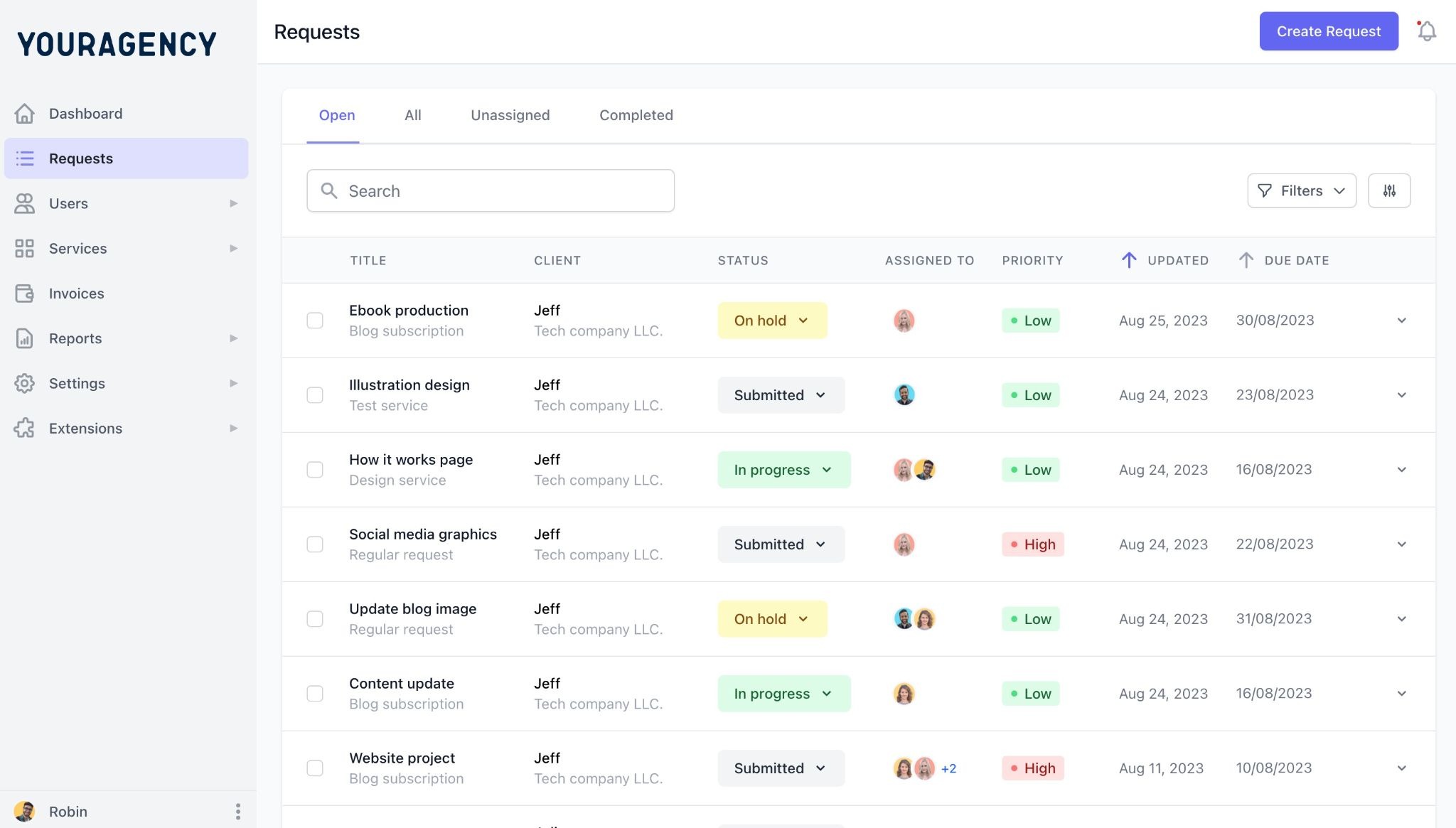
After switching, everything moved into one place. Clients get onboarded and submit project briefs directly. Projects get assigned to the right architect automatically. Revisions happen in the platform. Their project managers now have full visibility on project progress and architect capacity at all times, without chasing updates across tools.
The template covers all eight sections above. It's built for fixed-scope creative projects, not generic project management engagements. Each section has placeholder copy you can swap with your own details. The scope, revision, timeline, and payment sections include sample language you can copy directly into your next proposal.
Download the free project management proposal template here.
If your last project ran over scope or your client went quiet mid-delivery, the problem started in the proposal and the delivery system that followed it.
When your client signs, the proposal's job is done. ManyRequests handles what comes next.
Try ManyRequests free for 14 days. See what organized project delivery looks like from the moment your client signs.
FAQs
What should a project management proposal for a creative agency include?
A strong project management proposal for a creative agency covers the same sections as any strong proposal, plus three that most agencies skip: a revision policy, client responsibilities, and phased milestone payments. Together, these eight sections define what's included, who does what, and what triggers additional billing.
How do you prevent scope creep in a project proposal?
Write deliverables as a closed list with explicit exclusions. Add a revision policy that defines what a revision is. Include a change request clause that requires written approval before any out-of-scope work begins.
Should I include a retainer option in my project proposal?
Yes. Add a short ongoing support section at the end of every project proposal. Your best retainer clients start as project clients. A one-line ongoing support clause at the end of your proposal is the lowest-effort way to open that conversation.

.svg)